



Leigh Ann Roman is reminded that forgiveness starts at home.
I have heard it said that the most important phrases in family life are “Please, thank you, and I’m sorry.”
The last one is quite telling. It implies that family life might be less than perfect — made up as it is of very imperfect people. It suggests that we might have to bear with one another’s weaknesses and that we might even have to practice humility in asking forgiveness for our own.
That brings me to the spiritual work of mercy: Bearing wrongs patiently and forgiving offenses willingly. That can be so very, very difficult when we lose perspective, and we lose perspective when we forget our own flaws and focus on the shortcomings of others. This is something that I have been guilty of over the years, and it is a human tendency with which I still struggle. But none of us is perfect, and Christ came to show mercy to the world. He made it clear that we should show mercy too — so much so that the prayer He taught us says, “forgive us our trespasses, as we forgive those who trespass against us.” The practice field for this virtue is definitely the family.
The Definition of Forgiveness
So, what is forgiveness? According to the Merriam-Webster Dictionary, to forgive someone means to give up a resentment against them or the claim to requital for an insult. It could also mean to grant relief from payment of a debt.
This mirrors the definition offered by Father Mike Schmitz of Ascension Press in a short video on YouTube. He explains that forgiveness doesn’t mean that you have to trust or be friends with someone who has deeply hurt you. Indeed, it might be foolish to trust someone who has shown that they are untrustworthy. What forgiveness means is that you release that person from his debt to you.
Forgiveness is also an act of mercy to yourself because you release yourself from the resentment that can poison your thoughts and your relationships. Think of forgiveness as scissors that cut the strings binding you to a past problem or hurt.
Learning to Let Go
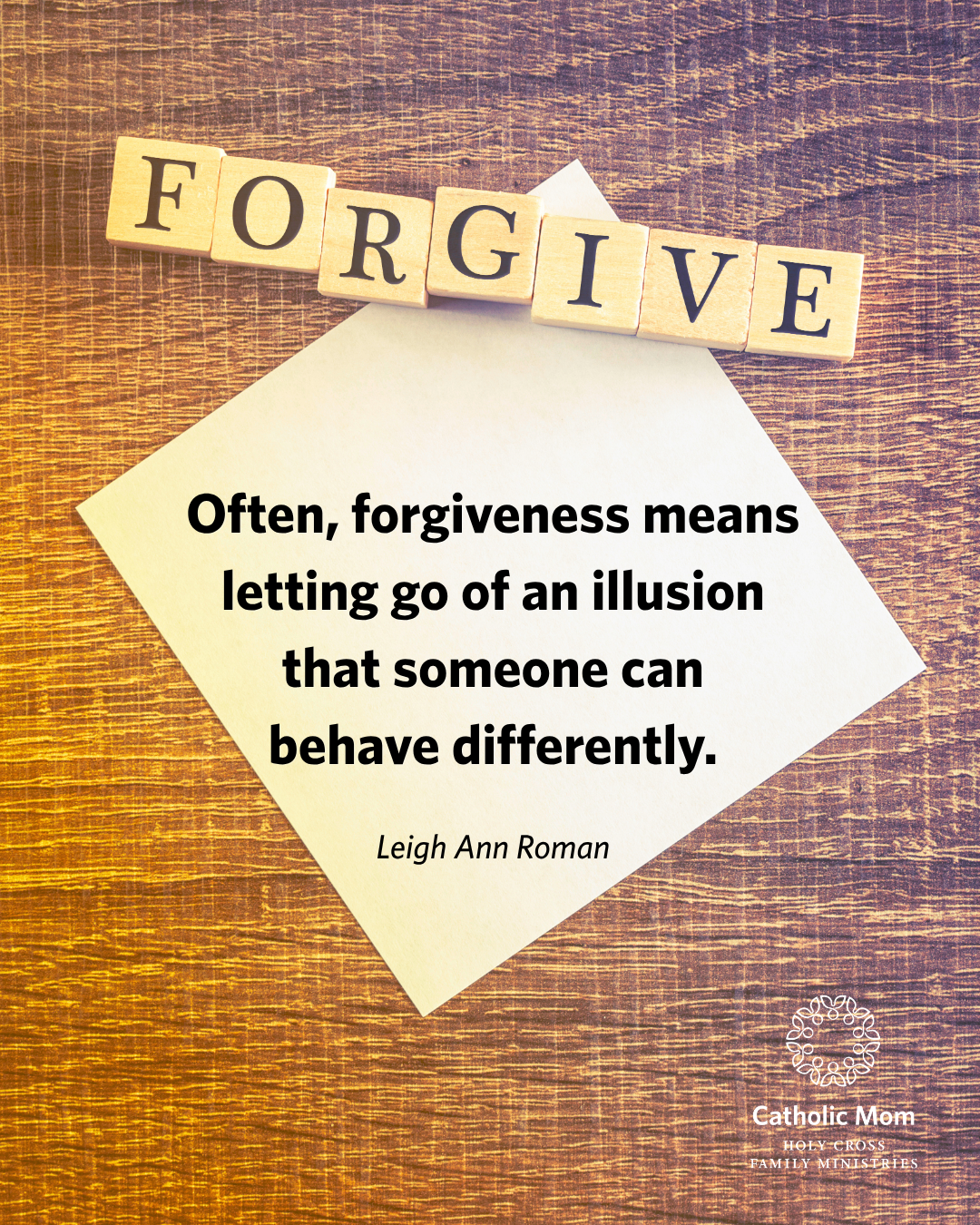
It is not easy. Often, forgiveness also means letting go of an illusion that someone can behave differently. Letting go of the idea that the perpetually late person could be on time. Or that the disorganized person can actually keep track of a busy family schedule without reminders. Letting go of the idea that your diabetic brother is suddenly going to start eating healthy and walking three miles a day.
Letting go of those illusions — or delusions — allows us to live in reality and not set ourselves up for the resentments that are the opposite of forgiveness.
Rather than looking at others and their transgressions, it is better to keep our eyes on Christ and remember that he sacrificed for all of humanity and that we are all sinners. It is also vital to remember that our faults may cause pain or discomfort to others. As Thomas à Kempis says in The Imitation of Christ,
Whatever we are unable to reform in ourselves or in others, we must clearly put up with until God chooses to change it. View this as being, perhaps, the better state, for by undergoing this test it teaches us patience without which all our actions carry little merit. ...
God has willed that we learn to bear one another’s burdens. Each of us has some failing and some trial to bear and none of us has the strength to bear them by himself, nor the wisdom. Therefore, we must bear with one another, comfort each other, support, instruct and advise one another. (The Imitation of Christ, 20-21)

That is grace, mercy, and forgiveness. In our fallen world, they are sorely needed. Yet every Christian can extend these gifts to others by first remembering that by God’s grace he has already received them.
Share your thoughts with the Catholic Mom community! You'll find the comment box below the author's bio and list of recommended articles.
Copyright 2026 Leigh Ann Roman
Images: Canva
An earlier version of this column appeared in the West Tennessee Catholic publication of the Catholic Diocese of Memphis.


About the Author


.png?width=1806&height=731&name=CatholicMom_hcfm_logo1_pos_871c_2728c%20(002).png "CatholicMom_hcfm_logo1_pos_871c_2728c (002)")


Comments