


Emily Jerger reviews a new book by Catholic Mom contributing writer Samantha Stephenson on gardening and cultivating both the soil and the soul.
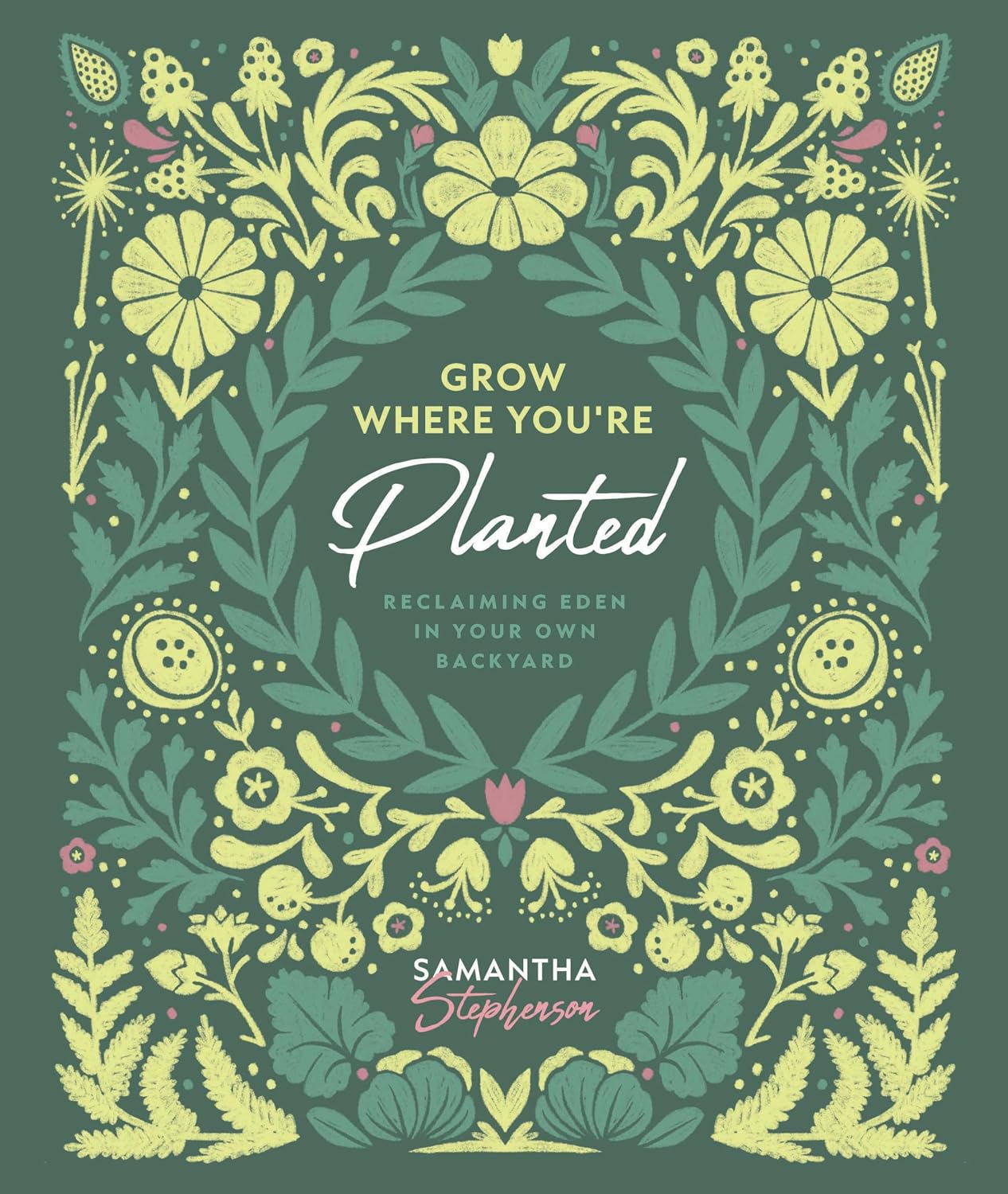
Grow Where You're Planted: Reclaiming Eden in Your Own Backyard
By Samantha Stephenson
Published by Sophia Institute Press
Grow Where You’re Planted: Reclaiming Eden in Your Own Backyard by Samantha Stephenson is not only a resource guide full of gardening tips, seasonal recipes, and activities for children, it is also a book filled with many spiritual lessons. Catholic Mom contributing writer Samantha Stephenson provides rich meditations and powerful insights that accompany the more practical guidance on how to grow and preserve food. This well-written guide to gardening is really the kind of book that serves not only as an inspiring one-time read, but a resource that someone can come back to again and again. It is a book sure to be relevant for everyone from the seasoned gardener to the mom who, like me, is not quite sure where to begin in her backyard.
From the introduction, I was caught up in the story of Samantha’s suffering as a mom with “bone-deep exhaustion” and Hashimoto’s. While her experience is different than my own, as an adoptive mom, I believe many mothers can identify with the inability to “access joy” during pregnancy, despite wanting to welcome another child. In the midst of Samantha’s season of darkness and depletion, gardening became a path of light and life.
Food for Growth and Food for Thought
The book follows the structure of the four seasons of the year, looking at the types of food and the accompanying food for thought that one can find in each season. Just as Jesus uses the image of soil and gardening to describe the spiritual life and to teach us about the kingdom of God, in her section on Spring, Samantha leads us to meditate on the parable of the soil. In this section, I was especially drawn to the description of Bellbind, a nasty weed that can easily destroy a garden. Samantha Stephenson is the author of another book, The Bellbind Letters, which she named after this destructive weed and which was inspired by C.S. Lewis’ The Screwtape Letters.
In Grow Where You’re Planted, Samantha compares struggling with the pernicious Bellbind to struggling with sin:
This is what sin does in our lives. It creeps over us, winding its way around, and chokes the life out of us. It covers us with deceptively delicate greenery and lovely blooms, enticing promises that ultimately offer nothing but the seeds of further ensnarement… Nothing but the regular cultivation of our souls and a dose of the Good Gardener’s grace can save us. If I leave my garden unattended for a week, I return to several hours’ worth of weeding. A daily examination of conscience helps us to extract the vices when they are small, before their deep taproots or runners establish control over us. Regular Reconciliation ensures that we weed out the worst within us. (p. 8-9)
Throughout her book, Samantha invites readers to see the correlation between cultivating the garden and cultivating one’s spiritual life.
In the Summer section, Samatha begins with a meditation on diligence and the importance of the virtues of prudence and faithfulness. She also describes what it looks like to be living “on the rims,” or the outside of what is essential. With honesty and simplicity, she describes how giving a talk to women can feel more satisfying than making sure her family has clean socks (p. 34). Her candidness pointed me towards my own temptation to get caught up in a number of good things that end up drawing me away from serving my family and caring for my home. I was challenged by Samantha’s words and brought back to consider my “primary vocation” as a wife and mother.
In the section on Autumn, Samantha introduces many of the practices that can help preserve a harvest. She draws on the practice of composting to illustrate the spiritual reality of how God can bring about good through suffering. She reminds us that, “Growing new life from the ruins of what was doesn’t happen on its own. It is possible only when we surrender ourselves to the Lord… Our Father wants to work miracles in our hearts through sufferings we’d rather let fall by the wayside. God doesn’t waste a thing.” (p.55-56) Beyond the spiritual insights, it was interesting and inspiring to read about the various ways food can be preserved, from canning or creating salts to fermenting or freeze drying.
In the section on Winter, Samantha leads us to reflect on the importance and necessity of rest. She reflects on how bareness and dormancy are necessary to balance with growth and harvest. She shares a humorous story about believing that her blueberry bushes had died when they became bare and then forgetting to pull them out, only to find a few weeks later that they were very much alive. Her experiencing of seeing “failure,” where “God saw what was still becoming,” is a good reminder of how God’s perspective is so much greater than our own (p.72).
At the end of Grow Where You're Planted, Samantha Stephenson returns to where we began, once again visiting the season of Spring and focusing on skills like pruning and crop rotation. She also offers readers several appendices, including a chart that serves as a planting guide that lists various vegetables and the ideal conditions at which to grow them, recipes to try, and further resources for those who want to dig deeper into gardening, homesteading, and healing through food. She also shares links to YouTube videos, podcasts, and printable downloads.
Fruitful Reading
An unexpected fruit of reading Grow Where You're Planted is my own growth in appreciation for how incredible our Creator is and how blessed we are with the abundant goodness of creation. I honestly had not given a lot of thought to the stewardship of the earth, the preservation of food, or the ways in which our cultivating a garden could also invite and welcome various animals or insects that depend on the land and our cultivation of it.
Growing up in a culture where grocery stores and fast-food restaurants provide so much of what I eat, it was eye-opening to think more seriously about growing my own food and what that would entail, not only for my family, but for God’s creatures as well. It was fascinating reading about beneficial flowers that, when cultivated together, deter pests and help the garden thrive. The idea of “companion planting,” reminded me of how we help one another as mothers and as women, when we share our unique gifts, perspectives, and experiences. There is strength in our diversity.
Samantha Stephenson definitely has a gift for writing and also for teaching and sharing her experiences in a way that invites the reader to enter in, without feeling overwhelmed. This book has given me a lot of things to consider when it comes to tending my own backyard. I know it will be a trusted resource for years to come.
Ask for Grow Where You're Planted at your local Catholic bookseller, or order online from Amazon.com or the publisher, Sophia Institute Press.
Is this a book you'd like to read? Share your thoughts with the Catholic Mom community! You'll find the comment box below the author's bio and list of recommended articles.
Copyright 2026 Emily Jerger
Images: Canva


About the Author


.png?width=1806&height=731&name=CatholicMom_hcfm_logo1_pos_871c_2728c%20(002).png "CatholicMom_hcfm_logo1_pos_871c_2728c (002)")


Comments