



Kristina Talbot explores the need to shift the questions of today’s youth by first adjusting the questions we ask them and shares 5 practical ways to connect with teens.
A friend recently inquired, “What do you believe is making young people more anxious today? Do you believe there truly is a rise in the prevalence of anxiety?”
I responded, "How much time do you have for an answer?"
Have no anxiety at all, but in everything, by prayer and petition, with thanksgiving, make your requests known to God. Then the peace of God that surpasses all understanding will guard your hearts and minds in Christ Jesus. (Philippians 4:6-7)
It is no coincidence that the rise in anxiety among youth happens to coincide with the advent of the iPhone and iPad era that was accompanied by social media. It would be an oversimplification to solely blame devices and mediums for the increase of anxiety among young people. There are numerous complexities to consider, and we as participants who interact with technology are just as much a part of the equation as the devices themselves if not more.
Who Are the Experts, According to Young People?
Ultimately, in recent years what has changed most dramatically is who young people turn to with their questions. Social media platforms, search engines, and ever-increasing AI technologies are considered the experts by today’s youth. Not only do these mediums provide immediate feedback, but they are also readily able to answer the questions posed to them. If it’s not the platforms themselves that are the problem, then deeper exploration reveals the reality that these platforms are simultaneously reshaping neuroplasticity and thus the very questions young people ask.
Instead of “Who am I?", youth today are asking, “What do I have?” or “What’s wrong with me?”. This fundamental shift in core questions of exploration yields a type of navel-gazing we’ve yet to see before now. The danger of such self-exploration is bound to end in unearthing the reality that each of us develops some imperfections within our frail humanity. However, the unique make-up of our giftings, essence, and form allows room for us to be made whole and marvelous — and thus do remarkable things. It would be unjust to our very humanity to merely ask what is wrong with me absent of also inquiring what is right with me.
Unfortunately, social media quizzes on mental-health symptoms fail to examine the entirety of the whole person through an objective lens. Access to various platforms feeding the sense that something must be wrong with oneself has fundamentally changed the way youth view themselves, along with their approach on the journey of adolescent self-discovery.
Before I formed you in the womb I knew you, before you were born, I dedicated you, a prophet to the nations I appointed you. “Ah, Lord God!” I said, “I do not know how to speak. I am too young!” But the Lord answered me, Do not say, “I am too young.” To whomever I send you, you shall go; whatever I command you, you shall speak. (Jeremiah 1:4-7)
Given the layers of the challenges young people face today the chasm between youth and parents can seem vast. Parents are challenged to grapple with the impact of the age of information upon us along with our children. There is need for a shift in our mission so that parenthood prioritizes the formation of the dignity of the whole person.
A Saint’s Example of Speaking to Young People
We can look to the example set by Saint John Paul II, who spoke directly to young people throughout his papacy. He traveled the globe and addressed youth with words of encouragement as well as mission. The model he demonstrated with such grace echoed the words of Jeremiah. He challenged young people to be a light while simultaneously reminding them who they were as God’s adopted beloved sons and daughters. His message was not watered down with soft wording or vague concepts, instead he provided a clarity in a relativistic world along with a difficult assignment.
I make my own the words of Saint Paul: “I have great confidence in you, I have great pride in you; I am filled with encouragement, I am overflowing with joy.” (2Cor 7,4).
These are not words of empty praise. I am confident that you have grasped the scale of the challenge that lies before you, and that you will have the wisdom and courage to meet that challenge. So much depends on you. (Saint John Paul II, World Youth Day at Denver 15 Aug 1993)
The experience of anxiety for young people today is often rooted in fear. Saint John Paul II’s primary message was, "Be not afraid.” Remembering this message is important in our formation as parents. But it’s worth considering what happens when we ourselves lack the words to respond to our children with patient endurance.
You need endurance to do the will of God and receive what he has promised. (Hebrews 10:36)
Now more than ever, youth need our undivided attention and reinforcement of who they are as well as whose they are. Saint John Paul II’s ability to remain relevant was rooted in his ability to listen. Much of his priesthood and work as a bishop was spent amongst his sheep, getting to know and developing an understanding of the stress and struggles youth faced.
We have an opportunity on car rides, at the table, while sitting on the couch to be curious about what is going on with our teenagers. Most often, they don’t readily share all their inner workings, but is important that we are not fooled by the façade of their distance and propensity to hide behind their screens.
5 Practical Ways to Support Your Teen:
- Have weekly and/or daily tech-free hours for the household.
- Ask open-ended questions. For example: Instead of ‘How was your day?’ ask something like, “What was something that held your attention today for more than 30 seconds?”
- Get comfortable with silence.
- Pursue your teen’s interest with them through active curiosity.
- Identify the ratio of task reminders vs. loving actions and work towards having more of the latter.

Be a Person They Can Turn To
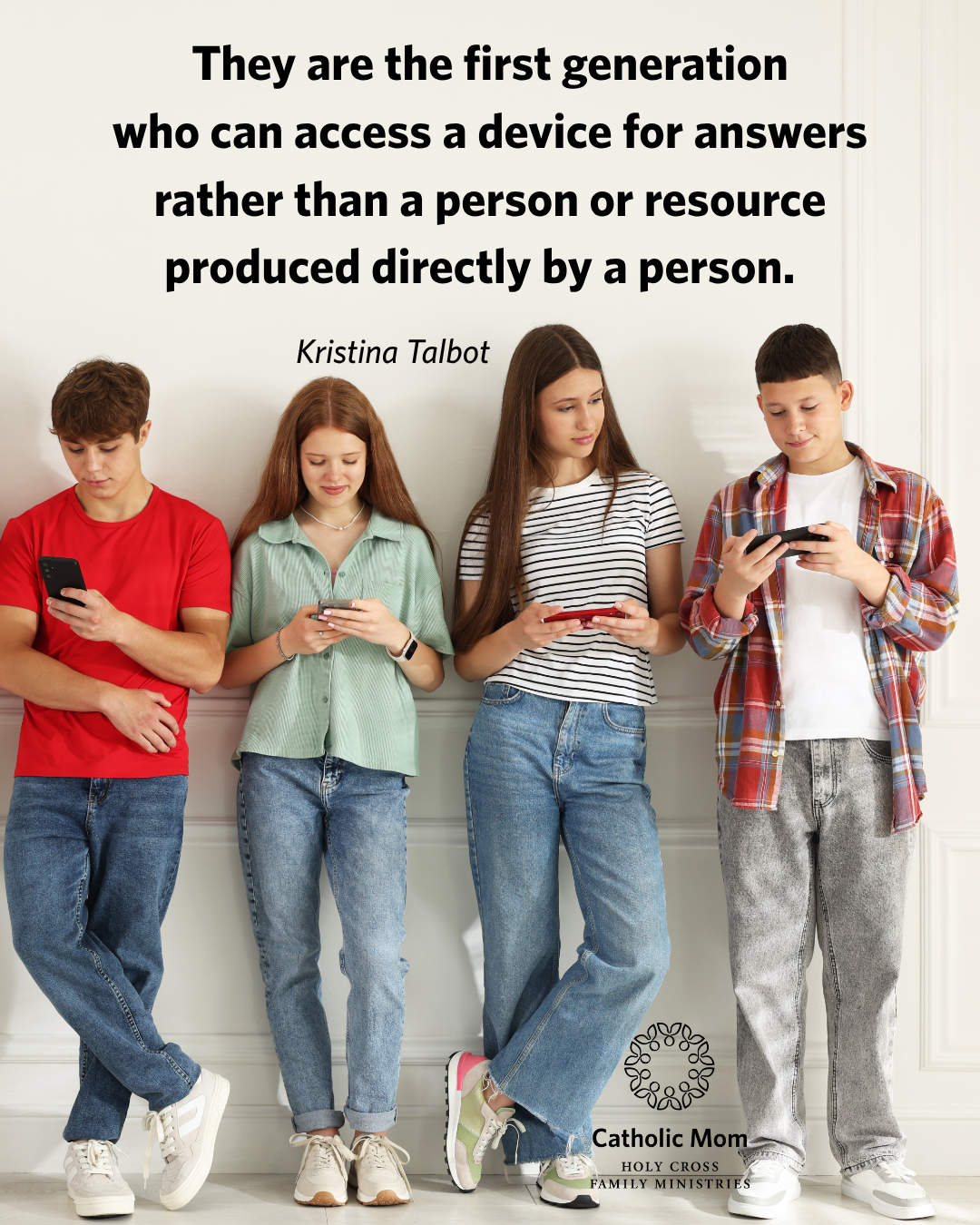
The anxiety young people are experiencing today is valid. They are not the first generation faced with a new frontier that brings with it new issues. But it is worth noting that they are the first generation who can access a device for answers rather than a person or resource produced directly by a person.
Being a person whom they can turn to is something we began developing the moment we first held them. However, residing in an age where one’s attention is now a commodity companies vie for warrants an even greater effort on our part to ensure that our teens know they have our attention. We are more likely to have their belief in our love when we share with them each day what is right about them.
Beloved, we are God’s children now; what we shall be had not yet been revealed. We do know that when it is revealed we shall be like him, for we shall see him as he is. Everyone who has this hope based on him makes himself pure, as he is pure. (1 John 3:2-3)
Share your thoughts with the Catholic Mom community! You'll find the comment box below the author's bio and list of recommended articles.
Copyright 2026 Kristina Talbot
Images: Canva


About the Author


.png?width=1806&height=731&name=CatholicMom_hcfm_logo1_pos_871c_2728c%20(002).png "CatholicMom_hcfm_logo1_pos_871c_2728c (002)")


Comments