


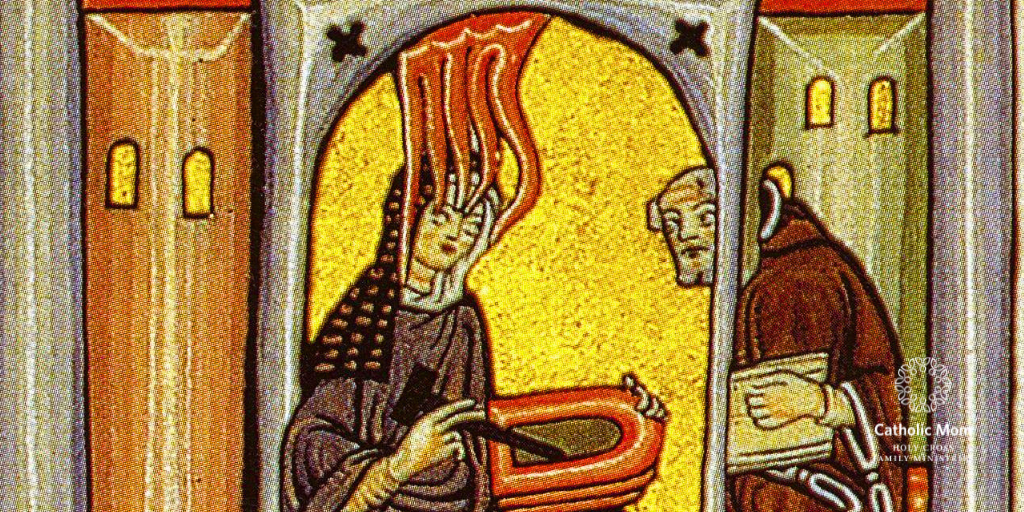
Natalie Hanemann recaps the life and impact of one of the few female Doctors of the Church, a saint who espoused the goodness of the natural world.
Woman may be made from man, but no man can be made without a woman. (Selected Writings)
Saint Hildegard (1098-1179) made this statement regarding the creation story in Genesis. She had a way of sparking attention with words and a perspective that fits well within the modern context. We don’t often hear about ecological defenders in the Middle Ages, yet we can be certain of one: Saint and Doctor of the Church, Hildegard of Bingen.
Hildegard espoused the goodness of the natural world and had a creation-focused spirituality. She believed the care of the earth was part of our responsibility as followers of Christ. She wrote, “We shall awaken from our dullness and rise vigorously toward justice. If we fall in love with creation deeper and deeper, we will respond to its endangerment with passion.”
Saint Hildegard is the most recent to join the ranks of female Doctors of the Church, along with Saints Teresa of Avila, Thérèse of Lisieux, and Catherine of Siena. What about this German abbess qualified her to stand among such spiritual giants? Even by today’s standards, her accomplishments impress. Her talents ranged from songwriting, preaching, medicine, and ecology. She is most known for having mystical visions, which she described through a variety of forms including songs, essays, and artwork. Her accomplishments are all the most impressive given she received very little education as a child.
One of 10 children, Hildegard was born to a noble family and began having visions when she was just three years old. When she was around ten, her family put her under the care of Jutta of Spanheim, a religious noblewoman, whom she lived with in seclusion until she was old enough to enter a convent. Hildegard became a nun at the age of fourteen.
She eventually became the abbess at Disibodenberg and later founded two other religious communities near Bingen. She began writing about her visions in her first work, Scivias, which received papal approval in 1151. She was a prolific writer whose deep love of the outdoors inspired several medicinal books, which natural healers still cite today. At sixty she “went on tour” in Germany, preaching and speaking to men and women, clergy and laity — something most unusual for a woman at the time.
She experienced a midlife awakening, “embracing a new life and spiritual path in her early forties, resulting in the most prolific and creative period of her life that continued into her early eighties.” (HealthyHildegard.com)
The following description of Hildegard puts her personality in league with other female saints in the history of the Church. “She was a staunch defender of the groups she led, traveling far distances when she felt the interests of her abbey were being ignored or threatened. She stood up to the patriarchal leadership of the day, and when she didn’t get the answer she wanted from her male superior, she would go over his head until she got what she needed. One time she even fell prey to a paralytic sickness until her wishes were honored, at which time God healed her of her illness."
The Greening Power of Creation
In contrast to the teachings of Saint Augustine and others who emphasized our depravity and the original sin that envelops us, Hildegard affirmed humankind’s inherent goodness. She wrote, “Every creature is a glittering, glistening mirror of Divinity.” This is not to say that Hildegard ignored evil or sin, but she believed that the spark of God within us was always greater than the temptation to do wrong. That’s why she could say, “Even in a world that’s being shipwrecked, remain brave and strong.”
One of Hildegard’s greatest contributions was her coining of the term viriditas. “The origin of Viriditas may be the union of two Latin words: Green and Truth. But like most Latin words, Viriditas does not easily translate into convenient, straightforward English. While being difficult to translate may be frustrating to some, there is beauty in this complexity.” The meaning is both literal (green and growth) and metaphorical (freshness and vitality). Viriditas is the creative power of life. Most of all, viriditas is God’s greening power, which “gives life to all things and inspires and revives our spiritual lives.” (HealthyHildegard.com)
The following is a poem Hildegard wrote to describe this creative power running through the natural world.
Viriditas
I am the one whose praise echoes on high.
I adorn all the earth.
I am the breeze that nurtures all things green.
I encourage blossoms to flourish with ripening fruits.
I am led by the spirit to feed the purest streams.
I am the rain coming from the dew that causes the grasses to laugh with the joy of life.
I call forth tears. I am the yearning for good.Good people, Most royal greening verdancy, Rooted in the sun,
You shine with radiant light, in this circle of earthly existence.
You shine so finely, it surpasses understanding.
God hugs you. You are encircled by the arms of the mystery of God.Amen. (Selected Writings)
Hildegard believed that God was the source of all viriditas. She viewed it as God’s greening power. But she also believed that we all have viriditas, this creative life power, within us. Healing comes when we figure out what is blocking our viriditas.
Speak!
Hildegard is credited with saying, “Dare to declare who you are. It is not far from the shores of silence to the boundaries of speech. The path is not long, but the way is deep. You must not only walk there, you must be prepared to leap.” It feels safe to assume Hildegard gave these words to other women, at a time in history when few women spoke, and fewer still were heard. The woman in the Middle Ages worked and bred children. They endured unsanitary conditions, suffered inequality, and cared for themselves and their loved ones at a time when disease was a silent and swift killer. How radical her message of self-proclamation must have seemed to her contemporaries.
It is said that during the darkest days of the Church, God takes special care to seed the population with saints who remind the people of their worth, who admonish sinners, and who care for the helpless. The Middle Ages, also referred to as the Dark Ages, was a time of the Black Plague, the Inquisitions, and limited education for people. With the help of saints like Hildegard, the Church finds renewal and restoration.
Hildegard Catches the Papal Spotlight
Three Popes in the modern era have elevated Hildegard’s popularity by bringing attention to her contributions to the Church. In 1979, Saint Pope John Paul II described Hildegard as a "light for her people and her time" on the occasion of the 800th anniversary of her death. Both Hildegard and John Paul shared a love for the natural world.
In 2012, Pope Benedict XVI proclaimed Hildegard a Doctor of the Church, emphasizing her "significant influence" and the lasting relevance of her writings on theology, liturgy, natural sciences, and music. He also highlighted her unique role as a female author in the Middle Ages.
Then in 2020, Pope Francis praised Hildegard as a "great" Doctor of the Church, recognizing her ability to connect scientific knowledge with spirituality and her teachings that benefited both men and women. He also mentioned her harmonious hymns and her challenge to prevailing restrictions on women.
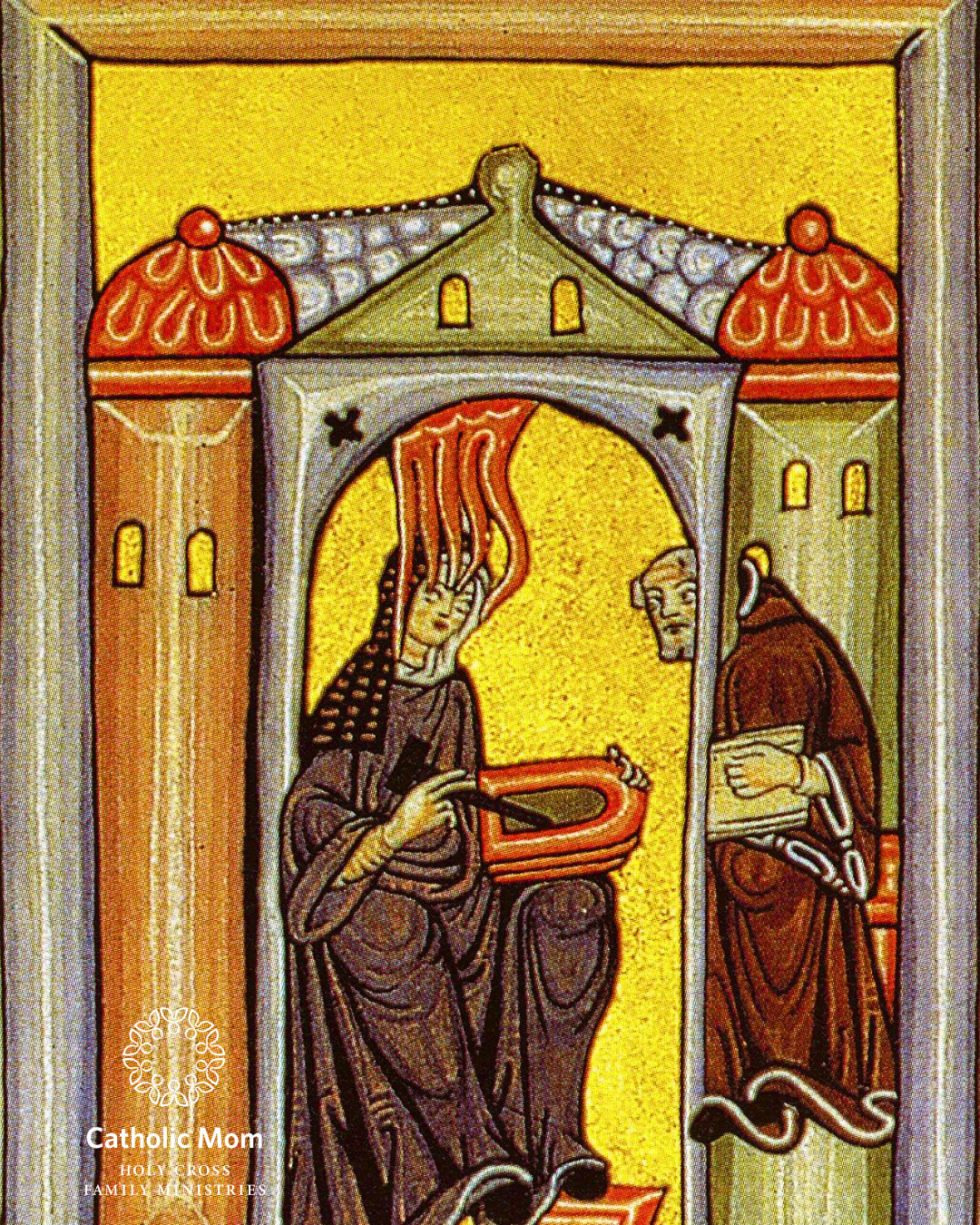
May we all remember Hildegard for her creative expressions and love of the natural world. As time has proven, it is never wasted to remind the world that carrying the light of truth where there is darkness leaves a lasting impression that can span centuries.
Hildegard’s feast day is September 17.
Share your thoughts with the Catholic Mom community! You'll find the comment box below the author's bio and list of recommended articles.
Copyright 2026 Natalie Hanemann
Images: (top, bottom) Public domain, via Wikimedia Commons ; (center) Canva


About the Author


.png?width=1806&height=731&name=CatholicMom_hcfm_logo1_pos_871c_2728c%20(002).png "CatholicMom_hcfm_logo1_pos_871c_2728c (002)")



Comments