


As gratitude is a key directive of our faith, Kathie Scott-Avery offers simple (and kid-friendly) guidelines for writing thank-you notes.
A group of us were sharing when-we-were-kids holiday stories and one recalled that, if he forgot to send a thank you note to his grandmother, she would call before long to ask why he was remiss in acknowledging her Christmas gift.
“Nowadays,” he lamented, “you’re lucky to get a mumbled ‘thank you’ even when you physically hand them a present.”
The head-nodding indicated it’s a common occurrence. Yet the remedy — providing tools and directions for expressing thanks — is simple.
According to Emily
According to my edition of Emily Post’s Etiquette, a note within a week is considered polite. What’s more, even very young children should convey appreciation, and that includes on paper if the giver was not already thanked in person.
Although Ms. Post’s name became synonymous with all-that’s-polite when her book became a bestseller in 1922, the argument for gratitude predates her. By quite a bit.

In the Beginning
In fact, one of the earliest is a cautionary tale from the dawn of history. Eve, in not appreciating and praising the lavish generosity of God, fell prey to the serpent’s craftiness.
Neglecting to send a thank you note isn’t on par with the Fall, but ingratitude is actually sinful.
Thanks to Saint Thomas Aquinas, who also predates the etiquette guru (in his case, by a mere six centuries), we have clarification. He explained gratitude as a derivative of the cardinal virtue of justice: we are directed by justice to give the good which is owed to another, and that includes rendering thanks. We aren’t entitled to what another gives us; we are indebted to them for their kindness.
Science Supports Manners
The command to thank those who gift our families with all sorts of tangible and intangible kindnesses may be enough to rekindle the habit of sending notes of appreciation.
But there’s more. (Isn’t that always the case?) God in His goodness, blesses the grateful.
Research, for example, repeatedly shows a strong correlation between authentic thankfulness and good mental and physical health. “Authentic” is important. "Say-thank you-to-Auntie" falls flat if there’s no cultivation of the proper virtuous context. Children need to be schooled in recognizing that, one, Auntie is not obligated to provide a gift for them, and two, that whether or not they like the present is inconsequential. Whatever is given calls for a grateful response. To go against that grain apparently stresses our minds and bodies.
Science also aligns with Church wisdom to reveal that thankfulness makes us happier. Perhaps it’s from basking in the warm revelation that another person thinks we’re worth the effort. Maybe expressing thanks simply provides an outlet for our delight. Or it could be that, deep in our souls, we appreciate the opportunity to be delivered from self-absorption and think about the giver.
And again there is more. Along with the opportunity to be a giver, our expression of gratitude makes the other feel appreciated. All this swapping of good cheer reaps a greater benefit: connectedness. Giving and receiving gifts, and giving and accepting thanks, contributes to building the relationships we crave. Even a scrawled “tHAnKYoU” or crayon drawing will travel many miles to adorn a refrigerator as a treasured heirloom.
Composing the Note
The practice need not be difficult nor time-consuming. Cards, for example, can be purchased in bulk. If your children are creatively inclined, add a ream of plain paper or sets of blank pre-cut cardstock with matching envelopes to your art supply shelf. Stocking up on whatever suits your lifestyle, as well as on stamps, will do wonders to keep your family within Ms. Post’s one-week deadline. For the very young, having them dictate a few words of appreciation or love makes a heartwarming caption to their artwork.
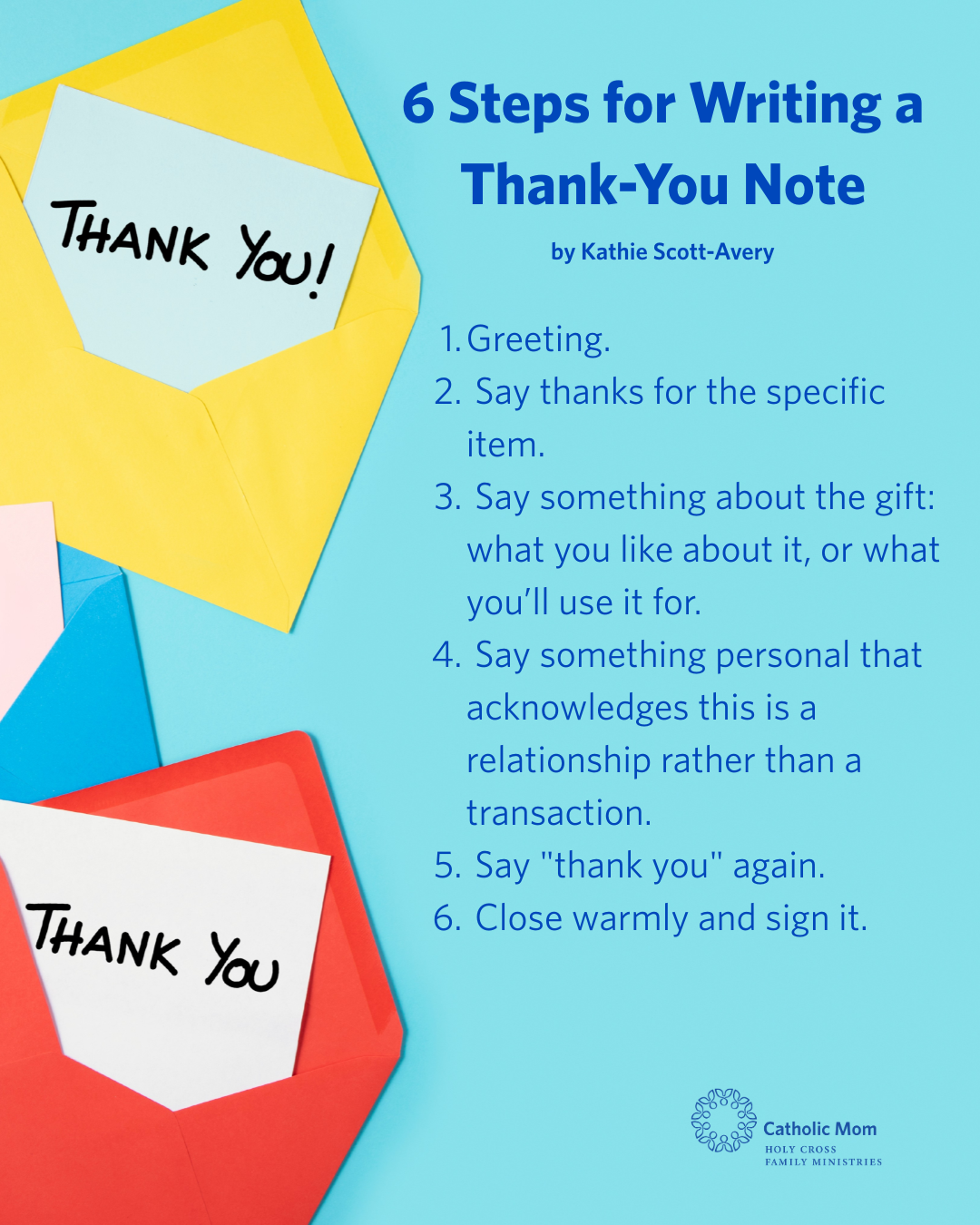
The basic components are as follows. Aside from the greeting and signature, the order can be changed and flourishes can be added according to the writer’s style or ability:
- Greeting.
- Say thanks for the specific item.
- Say something about the gift: what you like about it, or what you’ll use it for.
- Say something personal that acknowledges this is a relationship rather than a transaction.
- Say "thank you" again.
- Close it warmly and sign it.
Here is what one might look like:
Dear Aunt Cheryl,
Thank you for the sweater you sent for my birthday. My favorite color is blue, so I’ll be wearing it a lot!
I can hardly wait to see you at the next family reunion and hear about your vacation!
Thanks again for your thoughtfulness.
Love,
Joanie
The humble thank-you note is much more than an obligatory response to a gift. It’s an opportunity to build a bond between hearts.
Share your thoughts with the Catholic Mom community! You'll find the comment box below the author's bio and list of recommended articles.
Copyright 2025 Kathie Scott-Avery
Images: Canva


About the Author


.png?width=1806&height=731&name=CatholicMom_hcfm_logo1_pos_871c_2728c%20(002).png "CatholicMom_hcfm_logo1_pos_871c_2728c (002)")


Comments