



Laura Vazquez Santos reflects on work as ministry, encouraging working Catholic mothers to see paid and hidden labor alike as offerings that shape souls and sanctify ordinary life.
There is a quiet lie that sneaks into modern motherhood; one that whispers that only certain kinds of work “count.” This lie implies that ministry only happens in parish halls, not in playrooms or offices, and that holiness belongs to the women who have chosen either the boardroom or the homeschool table — but not both. Yet the Church has always insisted on something far more balanced and even radical: that work itself can be holy.
In Laborem Exercens, Saint John Paul II reminds us that work is not merely what we do, rather it is how we participate in God’s creative action and it distinguishes us from the rest of creation. It is how we become more fully human and it is not punishment; it is vocation. Saint John Paul II goes on to discuss how work can help to actualize our human capacities, and in this way upholds us in our dignity.
That includes the invisible, unpaid, underappreciated work that many parents do every day in raising children, and it can also include the professional work one completes outside of the home to help sustain one’s family. Many of us live these two roles at once (stirring soup with one hand while answering emails with the other).
This includes the mother who stays home and the mother who commutes. It includes the woman building a small business during nap time and the one clocking in at a hospital before sunrise. It includes the legal brief drafted at midnight and the math lesson explained for the fourth time before lunch. And both come with their own set of challenges, opportunities to practice applying virtues such as charity, and lessons to learn about holiness.
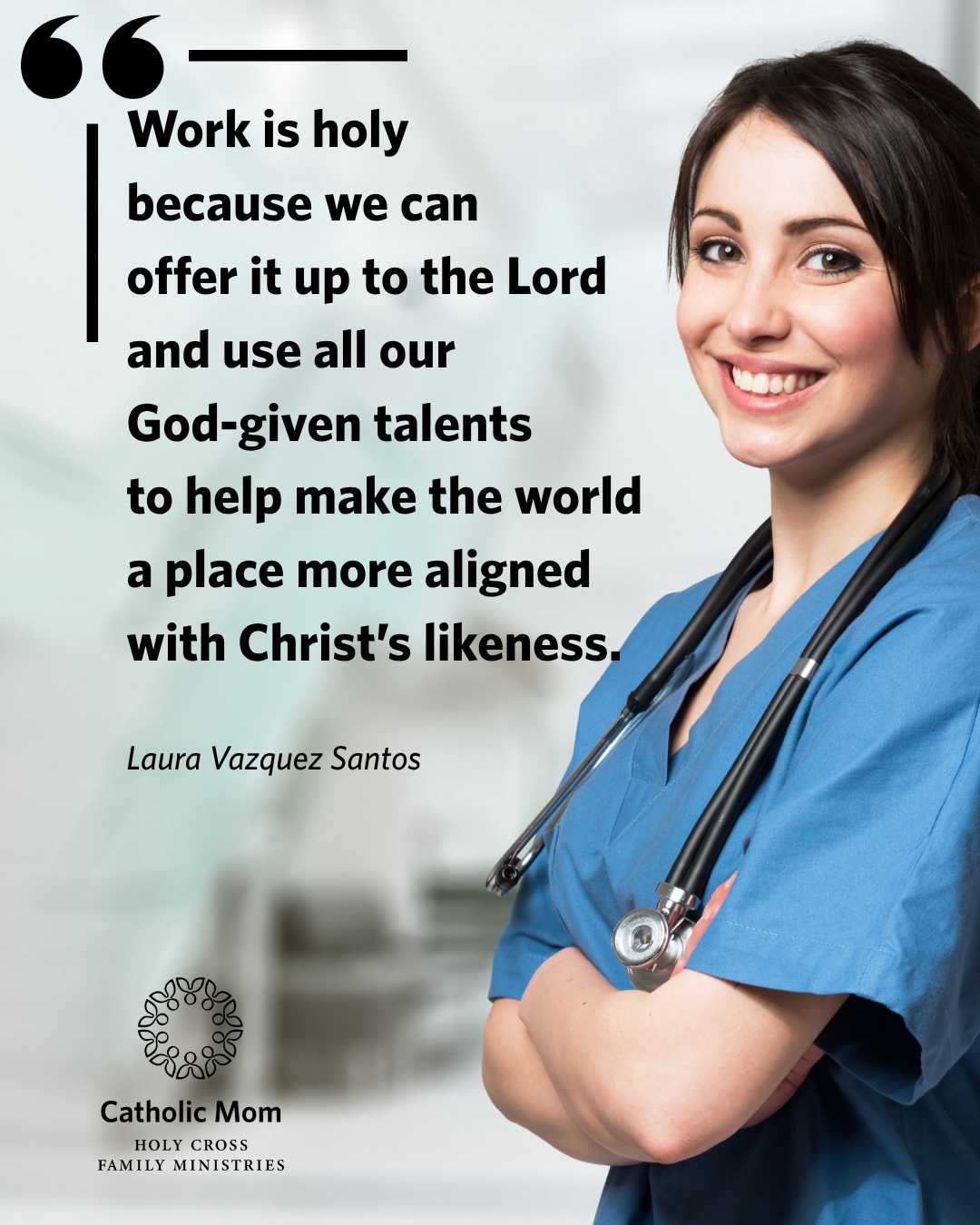
Thus, in this way work is not holy because it is glamorous; rather, it is holy because we can offer it up to the Lord and use all our God-given talents to help make the world a place more aligned with Christ’s likeness.
The Domestic Church Is Not a Metaphor
The Catechism calls the family the “domestic church,” and that is not merely sentimental language. It is theological, for a church is a place where sacrifice is offered and where love is made visible. So, if this is true, then the kitchen counter becomes an altar in the same way that the office desk can. When we wipe tears without applause and when we meet deadlines with integrity, we are not merely completing tasks: We are contributing to the work of shaping souls (including our own).
For working mothers, this truth is often overshadowed by a society that places one type of role above another. Society fragments women into competing categories: working mom, stay-at-home mom, part-time mom, side-hustle mom. The Gospel, however, does not. The Gospel asks only this: is it done with love? With humility? With your vocation as priority?
Martha, Misunderstood
We often pit Martha against Mary in the Gospel story (Luke 10:38-42), but miss the lessons illustrated by both women. Martha works and Mary listens. Martha is anxious and Mary is contemplative. In the case of Martha, her fault was not her work and certainly not her hospitality. Perhaps it was the interior distraction that kept her from becoming fully shaped into the holiness for which she was made.
Christ did not rebuke Martha for serving. He rebuked her for letting service (i.e. frantic busyness) and comparison sever her from Him. Martha allowed her hosting duties to take precedence over focusing on Jesus' presence and teaching, and her anxiety kept pulling her in different directions, all ones away from the Lord. That distinction matters.
You can be drafting contracts, answering client calls, packing lunches, and running carpools, and still be interiorly united to Christ and you can also be sitting in Adoration while mentally rehearsing tomorrow’s to-do list instead of being truly present with the Lord.
The battle is not between work and prayer. The battle is for recollection, for tranquility of mind, and for rightly ordered love.

For the mother whose work extends beyond the walls of her home, this is not a condemnation but an invitation to find ways in which all the daily work that you do can draw you closer to Christ. The question is not whether you work in the home or outside of it. Your office is not competition for your vocation, and your deadlines do not have to be rivals to your children (something I admit I struggle with often as well).
In fact, because everyone’s state in life (and circumstances) is different for reasons only God knows, we should all focus on discerning the path that God has willed for us as mothers, whether that be one alternative over the other or both simultaneously. You can sanctify a boardroom and a breakfast table, and you can lose yourself in distraction and anxiety in both places too.
Moreover, there are seasons when a mother’s work outside the home is not optional. For many of us, it is more a financial necessity than a professional calling. Sometimes it is both. Therefore, the focus is not, “Should a Catholic mother work?” The deeper question is, “How is God inviting our family to live faithfully in this season?” Discernment here is not ideological, but personal. It belongs to prayer, to prudence, to conversations with your spouse, and to honest evaluation of your family’s needs.
Martha’s story is not a warning against productivity; it is a warning against fragmentation and losing focus of the ultimate end: being drawn closer to Christ, not away from Him. And for the working mother who is answering emails between school pickups and offering professional excellence while also forming souls, integration becomes the quiet spiritual discipline of the day.
When Paid Work Becomes a Form of Ministry
Work outside the home can be ministry in very concrete ways. For example, integrity in the workplace, kindness in competitive environments, and competence offered with humility can be a form of witness. After all, we are called to be Christ-like, and work is a setting in which we can actively try to apply these virtues and be an example to others.
Children who see their mother work diligently, ethically, and prayerfully absorb a lesson no textbook can teach and that is that living out our faith is not confined to only going to church on Sundays.
Offering It Up Intentionally
Finally, despite what social media may sell to you, perfect balance is a myth. There will be seasons of hardship, competing demands, and difficult trade-offs as a working parent. The Christian measure is not flawless equilibrium but ordered love (fidelity to what God places before you today).
When we intentionally unite both paid and unpaid work to Christ, we move from mere endurance to participation in His sacrifice. Nothing is wasted when it is offered up with humility. And in that offering, work becomes formation where patience is stretched, pride is refined, and courage is strengthened.
Our children are shaped not only by our presence but by who we are becoming. Grace runs through desks and kitchen counters alike, and offered love, however ordinary it looks, is never small.

Share your thoughts with the Catholic Mom community! You'll find the comment box below the author's bio and list of recommended articles.
Copyright 2026 Laura Vazquez Santos
Images: Canva


About the Author


.png?width=1806&height=731&name=CatholicMom_hcfm_logo1_pos_871c_2728c%20(002).png "CatholicMom_hcfm_logo1_pos_871c_2728c (002)")


Comments