


Lindsay Schlegel reviews Our Lady of the Sign, a haunting, ultimately hopeful look into a woman’s modern-day conversion.
Our Lady of the Sign
By Abigail Favale
Published by Ignatius Press
Those familiar with the name Abigail Favale probably don’t think of her as a fiction writer. Though she won the illustrious Dappled Things J.F. Powers Prize for short fiction in 2017, she is more widely known for her two works of non-fiction: Into the Deep: An Unlikely Catholic Conversion and The Genesis of Gender: A Christian Theory. Currently a professor at the McGrath Institute for Church Life at the University of Notre Dame, Favale published her debut novel, Our Lady of the Sign, with Ignatius Press this summer.
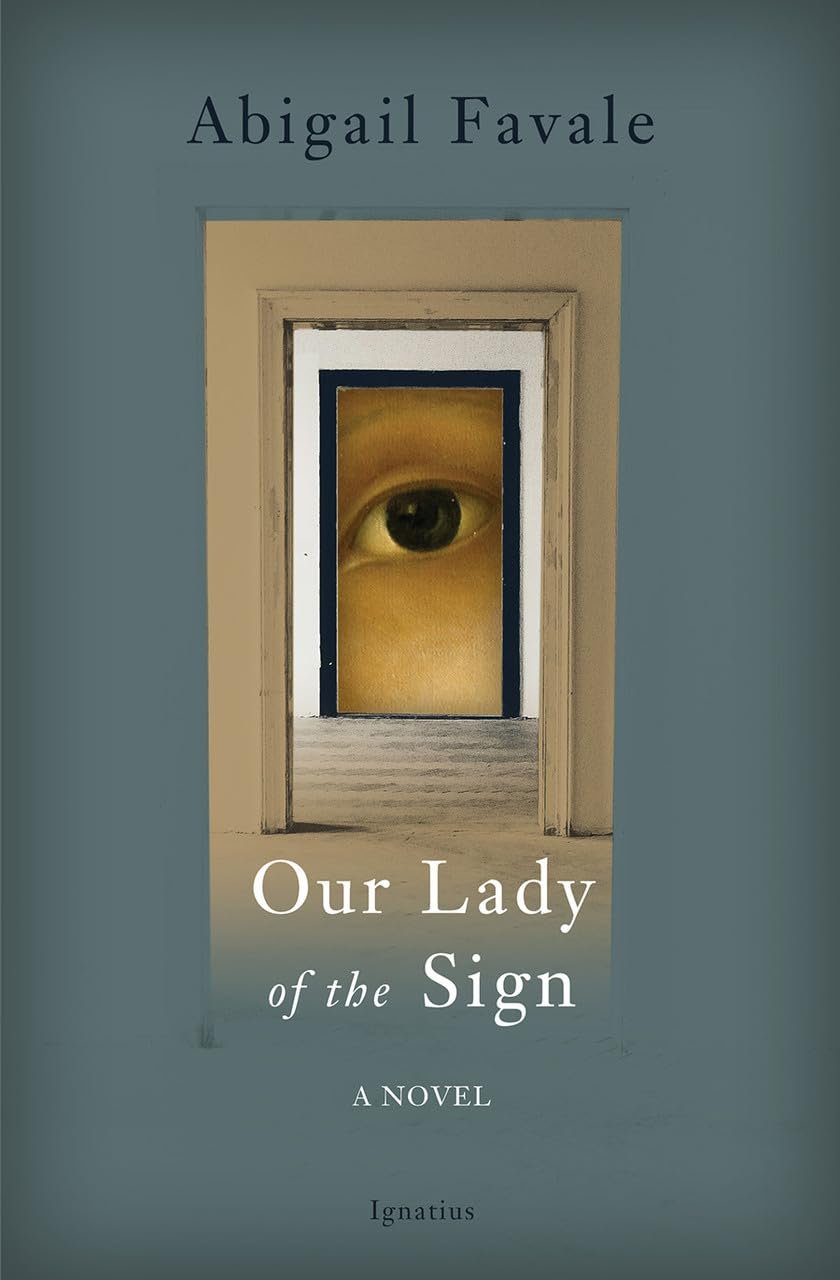
The novel’s title invokes an icon of Mary, the Theotokos, facing the viewer directly with her arms raised in the orans, or prayer, posture. The image is one that Favale’s protagonist, Simone Stark, is not at all familiar with. Simone does not claim any faith; she is a secular academic concerned only with the things of this world. Even there, a quiet struggle exists. Simone is more than jaded by the academy, but without options for another path forward. Her distant mother cares more about the career milestones Simone has achieved than she does. Though she’s not ready to articulate things this way yet, she struggles to find meaning in her work, purpose in her life.
Using a writing deadline as an excuse, Simone travels to the house, now a rental property, where she lived with her mother during her formative adolescent and teen years. There is something she needs to do, apart from writing, and this secluded place offers the ideal location.
Being back in the house is not a joyful trip down memory lane. The house seems to have a mind, a consciousness of its own. Simone has the inexplicable sense that someone else is there. Lights and doors ought to be inanimate; she remembered them to be so here. She attributes her discomfort to travel, the weather, the matter of the thing she’s come here to do. Revisiting the town isn’t much better. She has come unprepared — no proper coat, no proper boots — though these things are found easily enough at the local thrift store.
The discovery she doesn’t expect to make occurs at the Catholic Church, a place she’s been inside just once. Her mother, Cynthia, told her years ago that “Any woman who’s a Catholic is brainwashed,” and yet when Simone finds herself in a Catholic church during an Advent daily Mass, she finds that apart from the priest and one layman, everyone else present is a woman. She doesn’t know what’s happening in the liturgy and doesn’t want to be seen. Part of her, however, does want to come back.
A Return to Truth
In the course of the novel, Simone comes to realize that this view of Catholicism is not the only false idea Cynthia instilled in her. Her mother’s room was always closed off from Simone — unapproachable, all but verboten. That restriction, it turns out, was deeply rooted in fear and pain from her mother’s own girlhood. Though Simone’s mother worked in healthcare, she did not find life itself to be cause for celebration. When Simone got her first period, rather than rejoice in her growing maturity, she threatened Simone never to get pregnant.
Strange things happen in the house even without her mother there, worsening with each passing day. If Simone was unprepared without outerwear, she is far out of her depth metaphysically. She has no context, has had no formation or training to help her navigate the forces she finds she must contend with. If the prospect of a paranormal Advent story doesn’t quite add up, one need only think of Charles Dickens’ A Christmas Carol to see how profound such a premise might turn out to be. In that story as well as this, the past haunts the present, either demanding a change or forecasting a further fall.
A crucial decision made in high school, strongly influenced by her mother, has left more of a mark on Simone than she has ever thought to admit. Indeed, the rhetoric driven into her at the time — that she’d made the right choice — obfuscated the growing, festering evil the event welcomed in. Simone’s dreams now color her waking hours. Until the situation really escalates, Simone had not been able to see how she had been chained.
A return visit to the church yields a portion of exorcised salt that Simone sprinkles throughout the house. Never before would she have given credence to anything like a sacramental, but it is efficacious. If there is power in these blessed grains, how much more might there be in the faith that proffered it? Though it has taken a lifetime to get there, in a moment, Simone finds belief.
With the surrender of a simple plea, “I want to see,” every door in the house swings open. What was locked is made free. Truth is spoken. Simone will go home, her real home, and start again.
Our Lady of the Sign explores the themes of Favale’s academic work in language that is rich and compelling. Never didactic, the prose looks closely at the repercussions of sin that accumulate and compound when they are left unchecked for years, decades. Make no mistake, the novel insists, evil is real. It is stealthy and silent, greedy and ruthless. Grace is everything evil is not — hope and joy, peace and comfort. Grace, finally, is the way home.
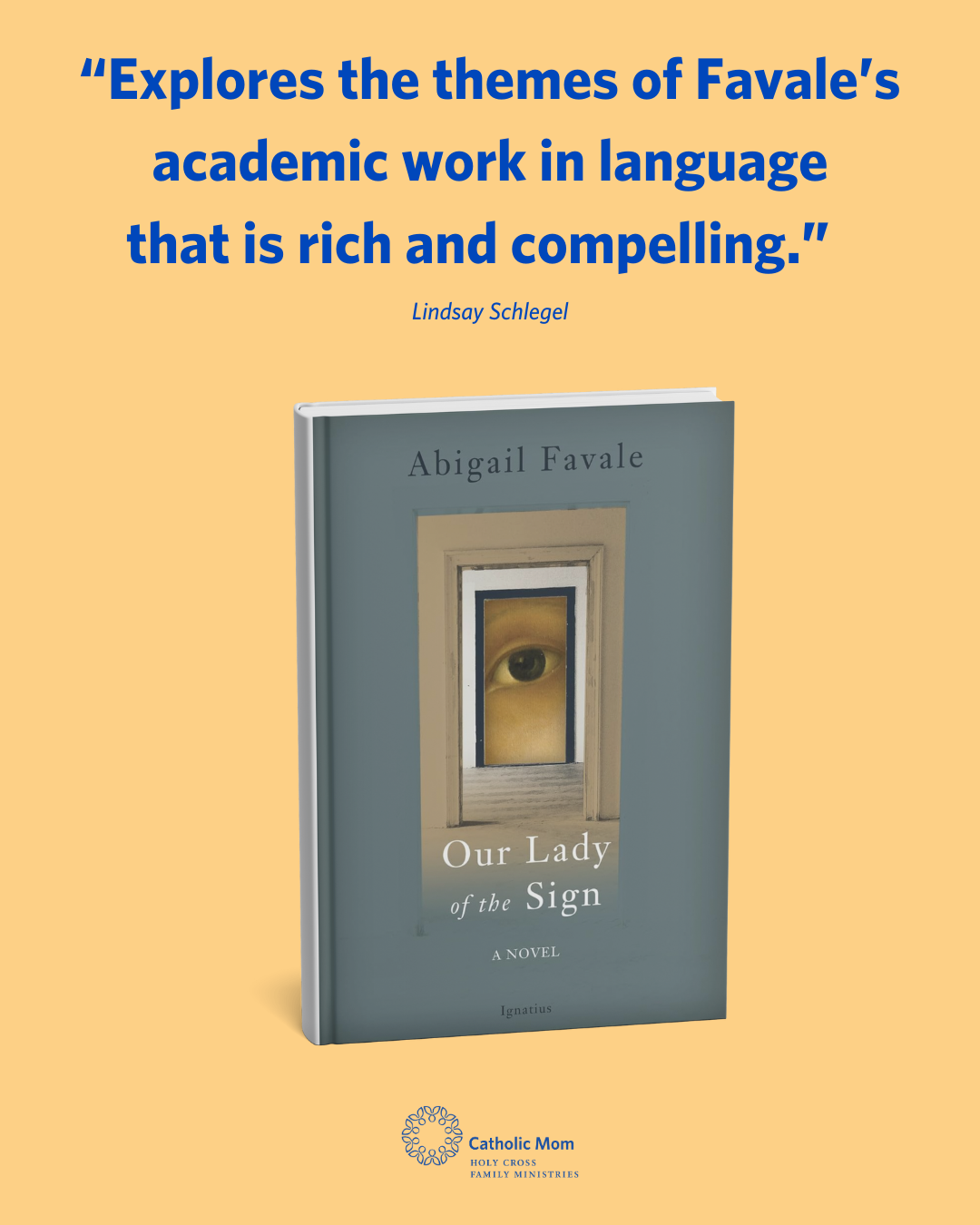
Ask for Our Lady of the Sign at your local Catholic bookseller, or order online from Amazon.com or the publisher, Ignatius Press.
Is this a book you'd like to read? Share your thoughts with the Catholic Mom community! You'll find the comment box below the author's bio and list of recommended articles.
Copyright 2026 Lindsay Schlegel
Images: Canva


About the Author


.png?width=1806&height=731&name=CatholicMom_hcfm_logo1_pos_871c_2728c%20(002).png "CatholicMom_hcfm_logo1_pos_871c_2728c (002)")

Comments