


With this brief description of Saint Dominic’s Nine Ways of Prayer, Kathie Scott-Avery offers encouragement to see if any enhance your own prayer life.
Normally, I start my day at the kitchen table with a cup of tea, the Morning Offering prayer, and a brief reflection centered on the day’s readings. Recently, however, I was prompted to tweak the routine ever-so-slightly by kneeling before a crucifix for the prayer.
It certainly wasn’t a novel idea; people often kneel to pray. Nor was the concept of changing my posture inventive. In fact, years ago, my then pre-teen daughter attended a talk about various postures based on Saint. Dominic’s Nine Ways of Prayer. Being young, her explanation to me afterwards wasn’t particularly detailed, and amid the busy-ness of our household at the time, my desire to find out more was soon forgotten.
Until now. From the first day I got out of the comfy chair and kneeled, I sensed a spiritual shift, an added attentiveness and intentionality. That, in turn, brought back the curiosity about what Saint Dominic had practiced.
Known as the Nine Ways of Prayer, this wasn’t a rule set by Saint Dominic but rather nine practices of his that were observed by those close to him and then anonymously written down. It’s generally agreed, and you’ll likely notice, that the first seven describe a physical progression toward greater communion with God while the last two recount devotional practices of the saint.
You may do some of them already. For example, but not surprisingly, I discovered that kneeling before the Crucifix and sitting at the table with spiritual readings were two of the nine.
In addition, several of St. Dominic’s postures are the same or similar to those assumed during Mass. Although familiar, however, we’re cautioned against modifying our communal worship to incorporate unsanctioned preferences. When coming together for Mass, each prescribed posture and gesture has a particular meaning aligned to that moment and, by acting in unison, we reaffirm that we are one in the Body of Christ. So, even where an alternate twist on tradition may seem attractive, we’re called to defer to the Mass rubric and reserve any divergent practice for enhancing other moments with God.
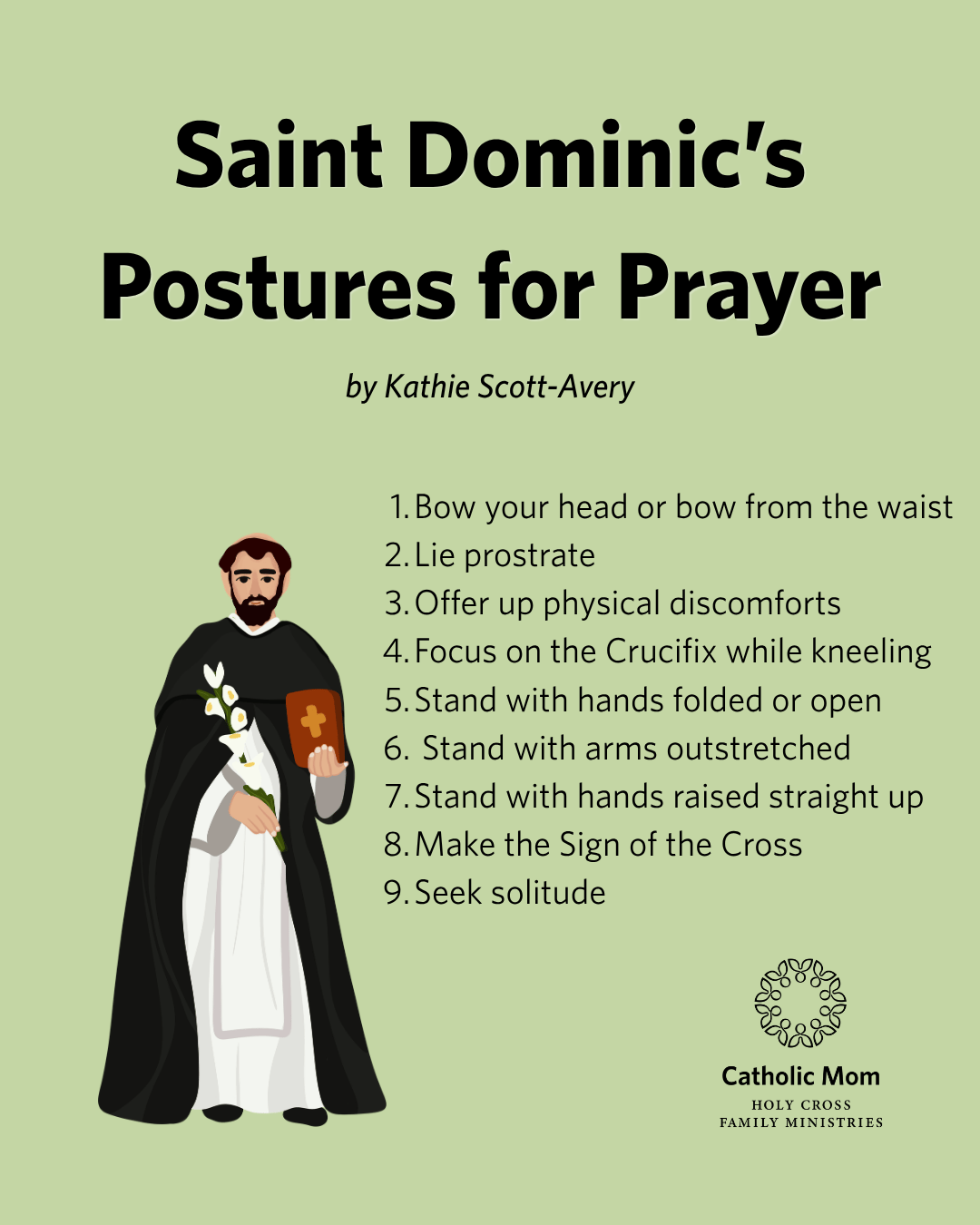
Saint Dominic’s Nine Ways of Prayer:
The First Way
Bow your head or bow from the waist to signify humility in being present before the Lord. Saint Dominic performed this humble gesture at the beginning of prayer, before the crucifix, at the altar, and at the mention of The Trinity.
The Second Way
Lie prostrate with remorse for your own sins as well as those of others, calling on God’s great mercy.
The Third Way
In Saint Dominic’s time, self-flogging was accepted for self-discipline and penance. Nowadays, while the intentions remain unchanged, The Third Way commonly calls for offering up any and all physical discomforts that arise naturally during prayer.
The Fourth Way
Focus on the Crucifix while kneeling, or repeatedly alternating between standing and kneeling, in wonder of and confidence in God’s goodness and mercy.
The Fifth Way
Stand erect, either with hands folded tightly or with hands open and raised as if holding a book or wider as if catching God’s grace as it falls from heaven, demonstrating an intense openness to and focus on God’s Word and direction.
The Sixth Way
Inspired by a sense of urgency or important need, stand with arms outstretched — as Christ’s arms were outstretched on the cross — in reverent and sacrificial supplication.
The Seventh Way
Stand with hands clasped or slightly open and raised straight up as if reaching for and even entering into heaven itself to receive an abundance of grace.
The Eighth Way
Seated quietly, make the Sign of the Cross and enter into the refreshing presence of God by reading spiritual material for reflection, meditation, and contemplation.
The Ninth Way
Seek solitude for meditation and deeper communion with the Holy Spirit, particularly in the midst of creation. Saint Dominic often practiced this while journeying by foot and, even when traveling with a group, he would distance himself from the others.
Gestures and Movements Have Meaning
Being both body and spirit, it’s not surprising that our prayer life benefits from incorporating both. The Church, as already noted, has always recognized this, as evidenced in the Mass and the sacraments. Even in casual conversation we see proof that our gestures and movements mean something. Our body language accentuates, to ourselves and to others, whatever it is we are attempting to achieve in communicating.
After diving into these described modes of prayer, I’m ready to try more. How about your prayer life? Do you consciously incorporate physical expressions in your prayers? What postures of Saint Dominic feel most natural to you? Which ones change your disposition toward prayer? Do you struggle with any particular posture and, if so, what about it is challenging?
Please offer your helpful comments or observations below!
Share your thoughts with the Catholic Mom community! You'll find the comment box below the author's bio and list of recommended articles.
Copyright 2026 Kathie Scott-Avery
Images: Canva


About the Author


.png?width=1806&height=731&name=CatholicMom_hcfm_logo1_pos_871c_2728c%20(002).png "CatholicMom_hcfm_logo1_pos_871c_2728c (002)")


Comments