


Yvette Buller describes how the prayers she learned as a child became a lifeline during a time of deep grief.
On the feast of Saint Dominic, whose Order of Preachers has been associated for centuries with the spread of the Rosary, I found myself thinking about what this prayer has meant in my own life.
I learned the words as a child. I prayed them for decades — no pun intended. But it took grief for me to begin to understand the Mother whose prayers I had been asking all those years.
The Rosary and Me
When I was a little girl back in the 1960s, my mother belonged to a Rosary group. Every few weeks, she would host the group at our house. Of course, we children had to participate — and be on our best behavior.
I remember one evening when the telephone rang. I jumped up from my knees to answer it, picked up the receiver, and said, “Hail Mary, full of grace — I ugh — mean, hello!”
I was so embarrassed. It became a funny memory later.
After several years, the Rosary group came to an end, so we were on our own when it came to praying it. As a child and teenager, I was only partly faithful to the Rosary.
Later, as a young married woman, I learned from my mom that the Rosary was aired frequently on EWTN. I began praying along with the Holy Land Rosary with Father Mitch Pacwa every weekday morning. It became part of my routine and helped keep me faithful to the prayer.
Fast-forward about 35 years.
COVID happened.
The lockdown came shortly after my son died. Churches were closed, access to the sacraments was limited, and my priest was not as readily available. I felt lost. I desperately needed the closeness I had known from sitting before the tabernacle or visiting with my priest.
So, I turned more deeply to prayer.
The Rosary: My Lifeline
In addition to my morning Rosary, I began praying a Scriptural Rosary using a booklet I had, and the Seven Sorrows Rosary.
These prayers became lifelines. Prayer was the only way I knew to survive, because whenever I was idle for any amount of time, the grief became overwhelming.
For years, I had heard people talk about having a devotion to the Blessed Mother. When they spoke about Mary, their faces would light up.
I wanted that.
I wanted to love her that way. I just didn’t know how.
At one point, I bought a huge piece of artwork of Our Lady holding the Child Jesus for my living room wall. I loved it, but it didn’t change anything. Even all those years of praying the Rosary hadn’t brought me to the kind of relationship with Mary that I saw in others.
But after my son died, everything changed.
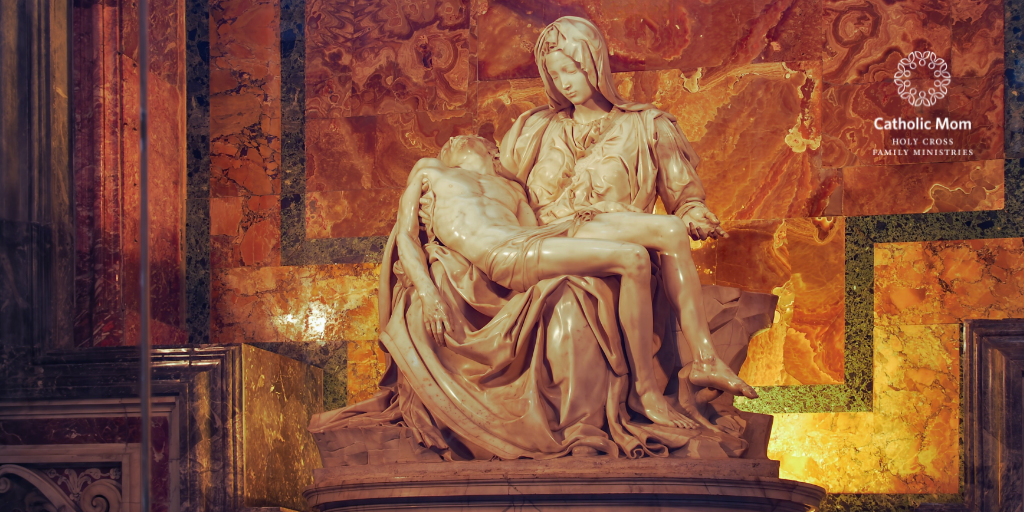
I began looking at the Pietà differently.
I could see Mary not only as the Mother of God, but as a mother who had held her dead Son in her arms, just as I had held mine.
Her Son is God — and yet, she is still His mother.
And He died.
In that moment, she had not yet seen the Resurrection. She knew the weight of loss.
And I knew that weight, too.
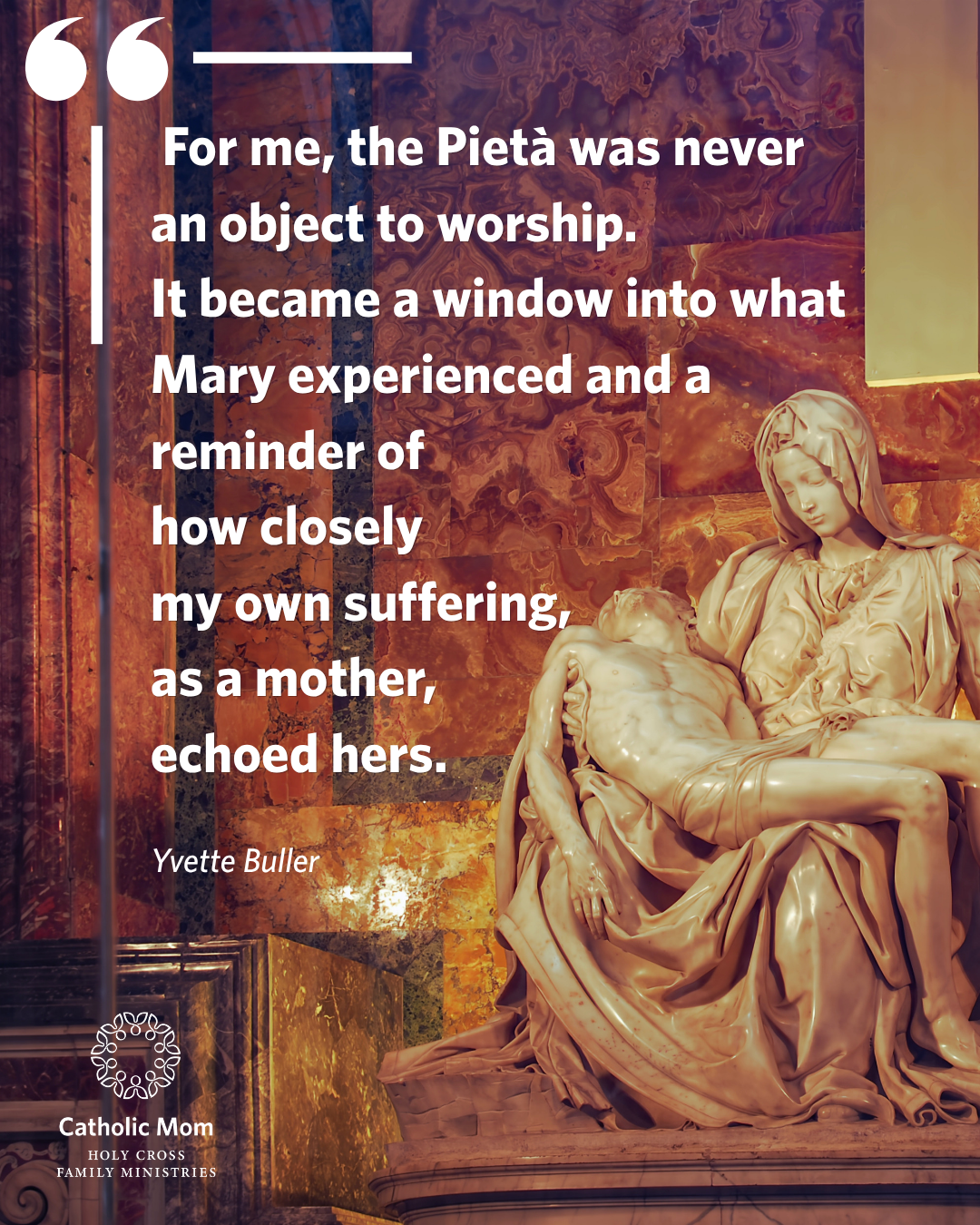
This is something I think many people misunderstand about Catholic devotion, especially those who struggle with our use of statues and sacred images. For me, the Pietà was never an object to worship. It became a window into what Mary experienced and a reminder of how closely my own suffering, as a mother, echoed hers.
Praying the Seven Sorrows Rosary touched something deep within me. Slowly, almost quietly, the devotion to the Blessed Mother that I had wanted for so many years began to grow.
Mary Shows Me Jesus' Love
Even in my work creating Catholic devotionals, I seek out the most beautiful images of Mary I can find. I am not talking about her physical beauty. I look for images that somehow reveal her heart — her tenderness, her sorrow, her love for her Son.
It has become a very intimate part of my work.
I think about Jesus and His Passion. I think about how He suffered and died for my sins.
I look at Him on the Cross, and I can see the love He has for me. How could I ever have doubted that He loved me?
It was through His Mother that I was able to get there. Through Mary, I could come close enough to her Son to begin to see and feel His love.
This is when the healing began.
I also think about Mary — His Mother, our Mother — and what she experienced that day. Her own sorrow.
I know something of that sorrow. I have been there.
But I also believe, as she did, in the promises of God. I believe in the Resurrection of the body, and I believe that on the last day I will see my son and my two babies again, reunited in heaven.
The Rosary Comes to Us
And that brings me back to Saint Dominic. There is an old and beautiful Catholic tradition surrounding Saint Dominic and the Rosary.
Tradition holds that Mary appeared to him and directed him toward the Rosary as an instrument for preaching the mysteries of Christ and calling people back to the faith.
The Rosary itself developed over centuries, so it would be too simple to say that Saint Dominic “invented” it. But the tradition of Mary placing this prayer into Dominic’s hands has endured in Catholic spirituality for centuries.
Perhaps that story has remained with us because it expresses something true about prayer.
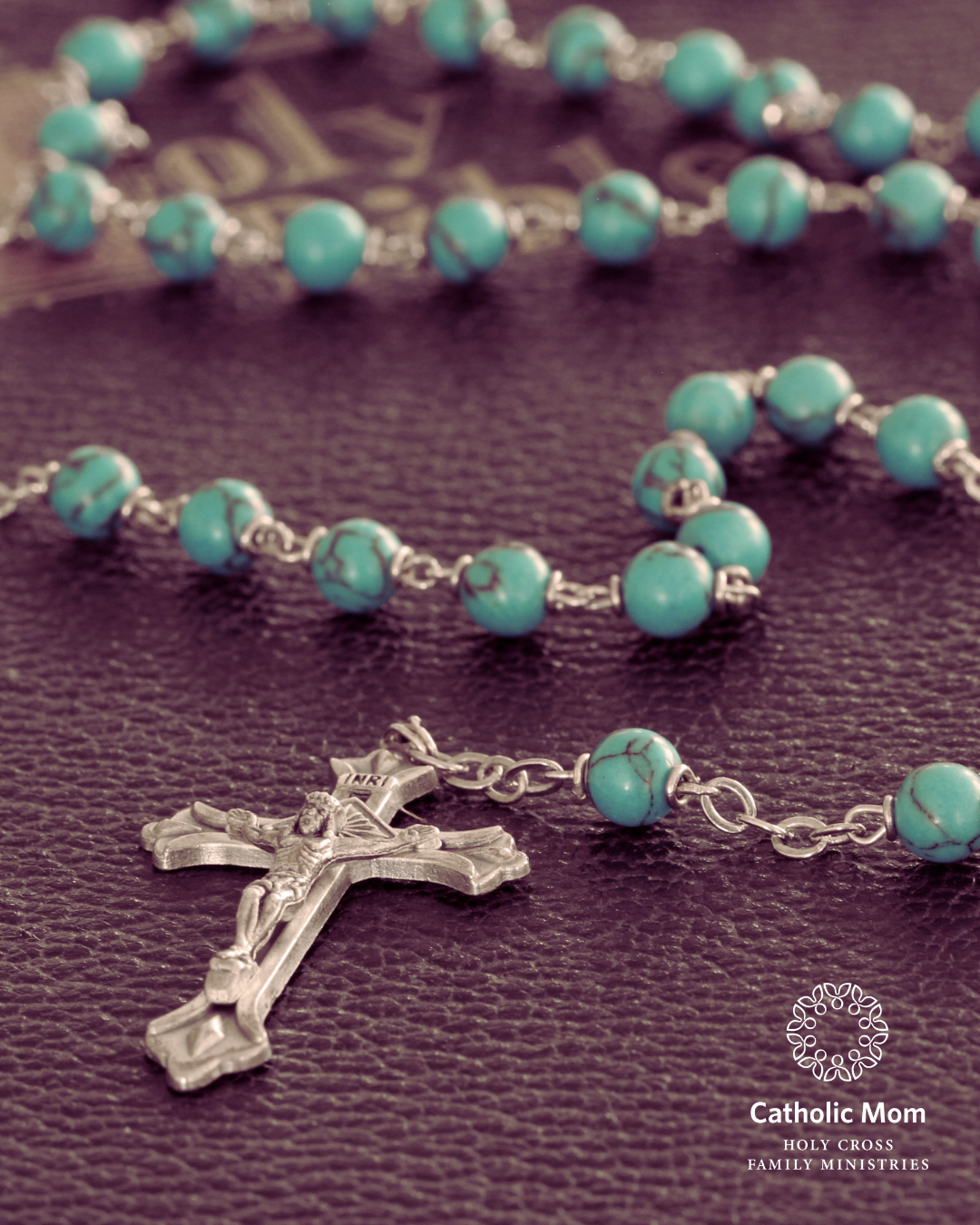
The Rosary comes to us when words fail.
According to the tradition, Dominic had labored and preached and struggled — and still found himself confronted by what he could not accomplish on his own.
And there, in his poverty, Our Lady handed him the beads.
That is not so different from what many of us have experienced.
The Rosary often finds us when we are not at our strongest. It finds us in the wilderness — lost, on our knees, begging for help we do not know how to ask for.
It found me in grief.
And in the tradition handed down about Saint Dominic, it met him in discouragement.
What Mary offered was not an explanation.
It was a prayer.
Bead by bead.
Mystery by mystery.
A way to stay close to her Son when nothing else was working.
Eight hundred years later, that same prayer is still being handed from one broken heart to another.
Share your thoughts with the Catholic Mom community! You'll find the comment box below the author's bio and list of recommended articles.
Copyright 2026 Yvette Buller
Images: Canva


About the Author


.png?width=1806&height=731&name=CatholicMom_hcfm_logo1_pos_871c_2728c%20(002).png "CatholicMom_hcfm_logo1_pos_871c_2728c (002)")


Comments