



Kate Taliaferro explores what parents need to know about AI, our intellectual heritage, and Pope Leo’s Magnifica Humanitas.
In light of Pope Leo’s recent encyclical, Magnifica Humanitas, as well as the many conversations happening online lately, my attention continues to swirl around AI. How to use it, when, if. And then there’s my kids. How do I purposefully teach them about AI when so much is changing so fast?
Using the Intellectual Gifts We Have: Intellectus and Ratio
No one can predict the future, much that parents would like to be able to. God did not gift us with foresight or clairvoyance. Instead, in His wisdom, He shared with us our intellectual abilities. Saint Thomas Aquinas explains that we have two, complementary concepts of “reason” and “intellect” at work when we discuss human intelligence:
The term intellect is inferred from the inward grasp of the truth, while the name reason is taken from the inquisitive and discursive process. (Antiqua et Nova #14)
In my understanding of Aquinas, intellect (intellectus) refers to the acquisition of new knowledge. It’s our insatiable curiosity as children to discover the names of the planets and where the constellations reside. It’s our wonderment at mixing colors together and learning how letters blend to become words. It’s our drive to plumb the depths of our chosen career field, recognizing that the quest for knowledge is worth our time and energy.
Reason (ratio), on the other hand, is what we do with the knowledge we have gained. We piece together the letter blends to form words, then sentences, and paragraphs. We select needed facts, coupled with experiences and advice, in order to make decisions and judgments about how to handle the next meeting with our boss or to diffuse a conflict with a friend. Both of these elements, intellectus and ratio, are necessary parts, the two sides of the coin that is human intelligence.
There is a cycle present between the intellectus and the ratio. The quest for the truth, to know something with certainty, cannot be completely fulfilled without the part of ratio making a reasoned decision concerning what was claimed. In the same way, there wouldn't be anything to make rational decisions about if the search for truth is abandoned. With the improper use of AI, there is a danger of splitting these unified parts of our intellectual ability.
Abdicating Our Gifts
When AI takes over the ratio side of intelligence, we abdicate our ability to make decisions for ourselves. We abandon the free will that God so graciously gave us and we allow an algorithm, which bases its information on trends, to make choices for us. It could be planning a vacation based on where everyone else goes. It could be financial advice. In the most serious cases, we have already seen AI offer life-altering, indeed life-threatening, counsel.
Just as serious is when AI takes over the intellectus. When asking an AI model a question, it has been trained to give a positive, definitive answer. But what if the answer is wrong? What if the answer the quester actually needs to hear isn’t one that reinforces his/her world view, but one that challenges it? What if multiple answers would have been beneficial, because then the ratio could engage in discerning which answer(s) have greater merit than others?
While yes, when asking a question on Google or other search engines there are algorithmic protocols that determine which websites to show a person first, the person still retains their free will to select which sites to visit. How many they choose, whether to stick with the first page or to skip to page 25, how much to read on each site — the quester maintains their free will. It works similarly to a library. The person is able to decide what to read, how many books to read, and what sections to look in to find an answer.
The kicker is that both of these pieces of our intellectual inheritance require time to fully realize. It takes time to discover the answers to a question. It takes time to then rationally determine how to use that new information. With AI, a shortcut appears to have been taken. Ask a question, get the answer given in a definitive, authoritative way, and move forward. No extra thinking required. Pope Leo writes,
The speed and ease with which answers or summaries can be obtained risk extinguishing the desire to ask questions, which is a process that bears fruit only over time. (MH #140).
Using the Time We Have Well
Time is our most precious commodity. How we choose to use, to spend, our time tells an outside observer much about our priorities and the goals. If AI should be saving us so much time and energy, what are we using those savings for? Are they bringing us closer together in community? Or are they encouraging us to see ourselves as self-sufficient, capable of attaining the answer to any problem without needing others?
Pope Leo reminds us that AI is not neutral and should not be treated as such. Nor, importantly, is it the great evil of our time that we should be doing all we can to depose its newfound place in society. Rather, he calls us to step up to the plate. He asks us to see the positive possibilities while honestly assessing the potential for division, despair, and disordered relationships.
It is not enough for artificial intelligence to make us more efficient or connected; it must also serve to build a universal human family, with shared rights and duties, where digital proximity becomes a real opportunity for encounter and mutual care. (MH #187)
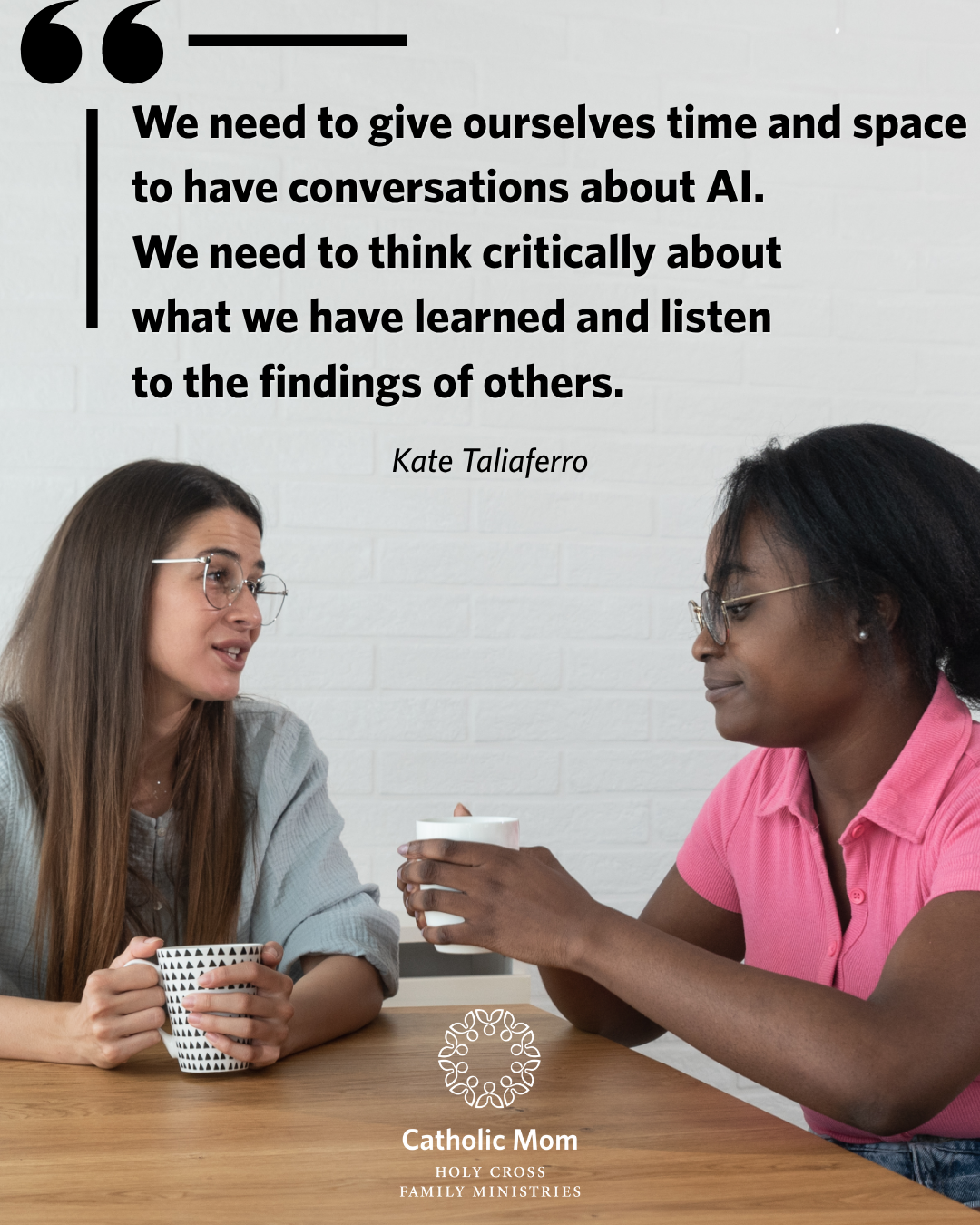
As parents we have to rapidly engage both our intellectus and ratio in the AI conversation. We need to pay attention to the advances and developments of AI. It is part of the human story and quickly becoming an integrated part of daily life. This means we need to, with intention, learn both its uses as well as its foundations. We then need to give ourselves time and space to have conversations about AI. We need to think critically about what we have learned and listen to the findings of others. There will not be clean, clear-cut answers like ChatGPT or Claude can offer. It will be messy; it will take time, energy, and space. But our families will be better for it.
Share your thoughts with the Catholic Mom community! You'll find the comment box below the author's bio and list of recommended articles.
Copyright 2026 Kate Taliaferro
Images: Canva


About the Author



Comments