



Maria Morera Johnson shares how grandparents, aunts and uncles, cousins, and godparents are part of the spiritual life of the family.
In many cultures, faith is transmitted primarily within the nuclear family: parents and children. However, the experience of faith can have a broader, more integrated, more community-minded character. It is not limited to the walls of the home, but expands to grandparents, aunts and uncles, cousins, godparents, and even close neighbors who become family. This network of relationships not only sustains everyday life, but also nurtures and strengthens faith from generation to generation.
The Domestic Church in Action
The extended family acts as a kind of "extended domestic church." It is in this space that faith is lived in a concrete, visible, and constant way. Grandparents, for example, play a fundamental role. They are custodians of the family's spiritual memory: they teach traditional prayers, narrate stories of faith, share popular devotions, and model an intimate relationship with God that has often been forged in the midst of sacrifices and trials. The image of a grandmother praying the Rosary aloud or a grandfather blessing the table is not simply a pious gesture; it is a living catechesis.
Godparents, another key figure in the extended family, also play a significant role. Beyond a sacramental formality, sponsorship in many cultures implies a spiritual responsibility. Godparents are called to accompany the life of faith of their godchildren, to be a guide, example and support in important moments. This relationship creates an additional bond that reinforces the sense of belonging and commitment to the faith.
Family celebrations are another privileged space where faith is present. Baptisms, first Communions, Confirmations, weddings, and even funerals become moments of encounter not only social, but also profoundly spiritual. On these occasions, the extended family gathers to celebrate, but also to pray, give thanks, and trust in God. Religious traditions such as posadas in Advent, the recitation of the Rosary at wakes, or pilgrimages are transmitted and lived collectively, creating a shared identity that strengthens faith.
In addition, daily life within this family network is permeated with small gestures of faith. An aunt who recommends entrusting herself to a saint, a cousin who invites her to Mass, a grandfather who remembers the importance of offering suffering, or a mother who offers a blessing before leaving home are simple acts that form the believing hearts of the youngest. Faith is not presented as an abstract theory, but as a reality embodied in human relationships.
The extended family also offers crucial support in times of difficulty. When a person faces illness, loss, or crisis, they are not alone. The family community is mobilized, not only with practical help, but with prayer, presence, and hope. This concrete experience of love in solidarity reflects God's love and strengthens trust in Him. In this sense, the family becomes a tangible sign of Divine Providence.
A Safe Place for Forgiveness and Reconciliation
However, not everything is ideal. The same closeness that characterizes the extended family can bring tensions, differences, and hurts. Differing opinions, generational conflicts, or different styles of living the faith can create friction. But even in these challenges there is an opportunity to learn to live charity and practice forgiveness and patience. Faith matures not only in harmony, but also in the ability to love in the midst of imperfection.
In the current context, marked by migration, geographical dispersion, and cultural changes, the extended family faces new challenges. Many families no longer live near each other, and traditions can fade over time. However, the community spirit is still alive. Calls, messages, virtual meetings, and occasional visits continue to be spaces where faith can be shared. The intention to stay united, even at a distance, reflects a deep value on family and faith.

It is important to recognize that this spiritual and familial richness is a gift for the Church. The extended family offers a model of how faith can be lived in community, sustained by intergenerational relationships and expressed in everyday life. While the culture often promotes individualism, this witness reminds us that faith flourishes best when it is shared.
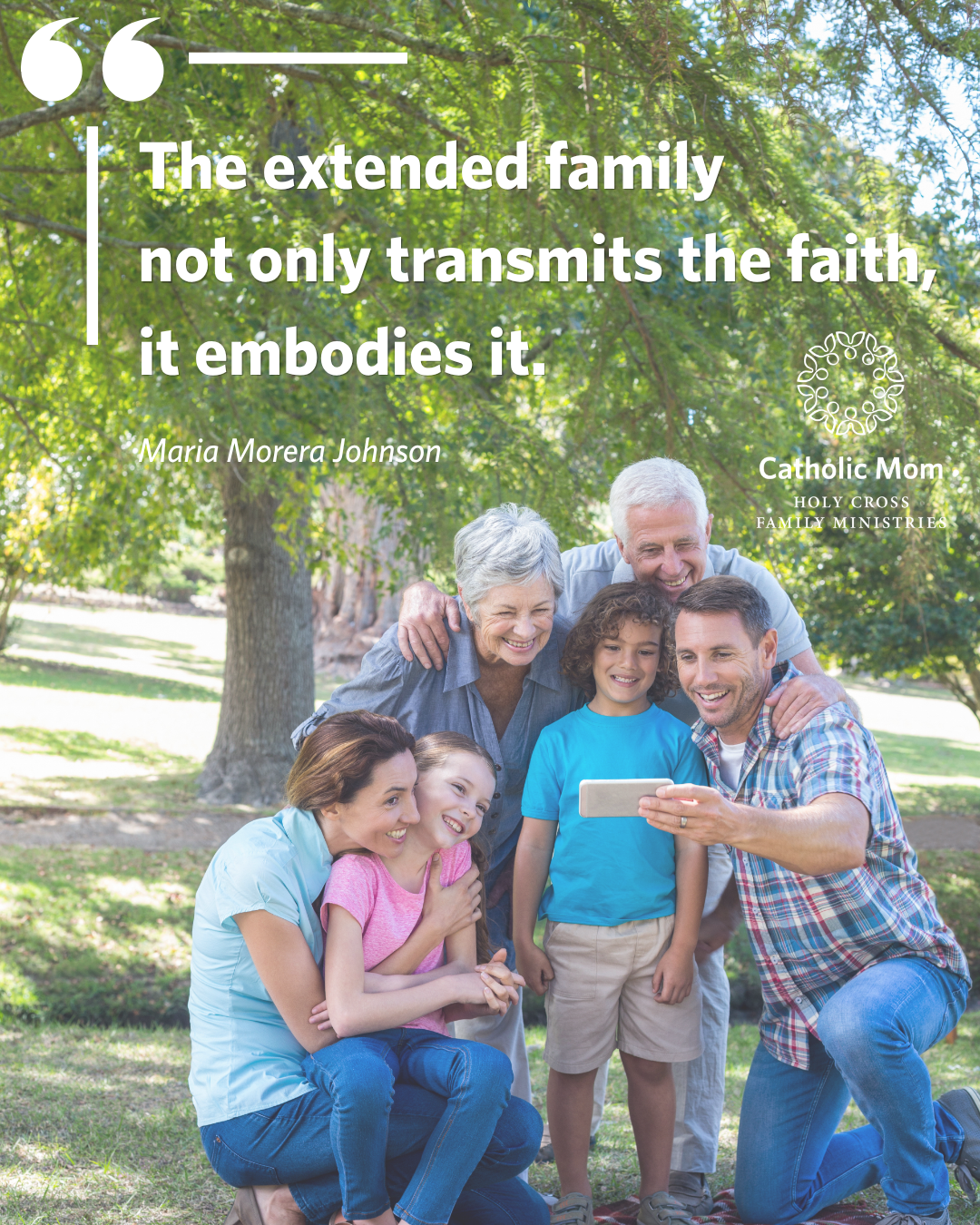
In short, the extended family not only transmits the faith, it embodies it. We make it visible in gestures, words, and traditions that are repeated and renewed with each generation. It is a space where we learn to believe, to hope, and to love. And in this network of relationships, faith is not only preserved, but grows, strengthens, and becomes a living legacy.
Share your thoughts with the Catholic Mom community! You'll find the comment box below the author's bio and list of recommended articles.
Copyright 2026 Maria Morera Johnson
Images: Canva


About the Author


.png?width=1806&height=731&name=CatholicMom_hcfm_logo1_pos_871c_2728c%20(002).png "CatholicMom_hcfm_logo1_pos_871c_2728c (002)")


Comments