


Kathryn Swegart reviews a new film that seeks to prove the existence of God based on scientific research into the universe and the cell.
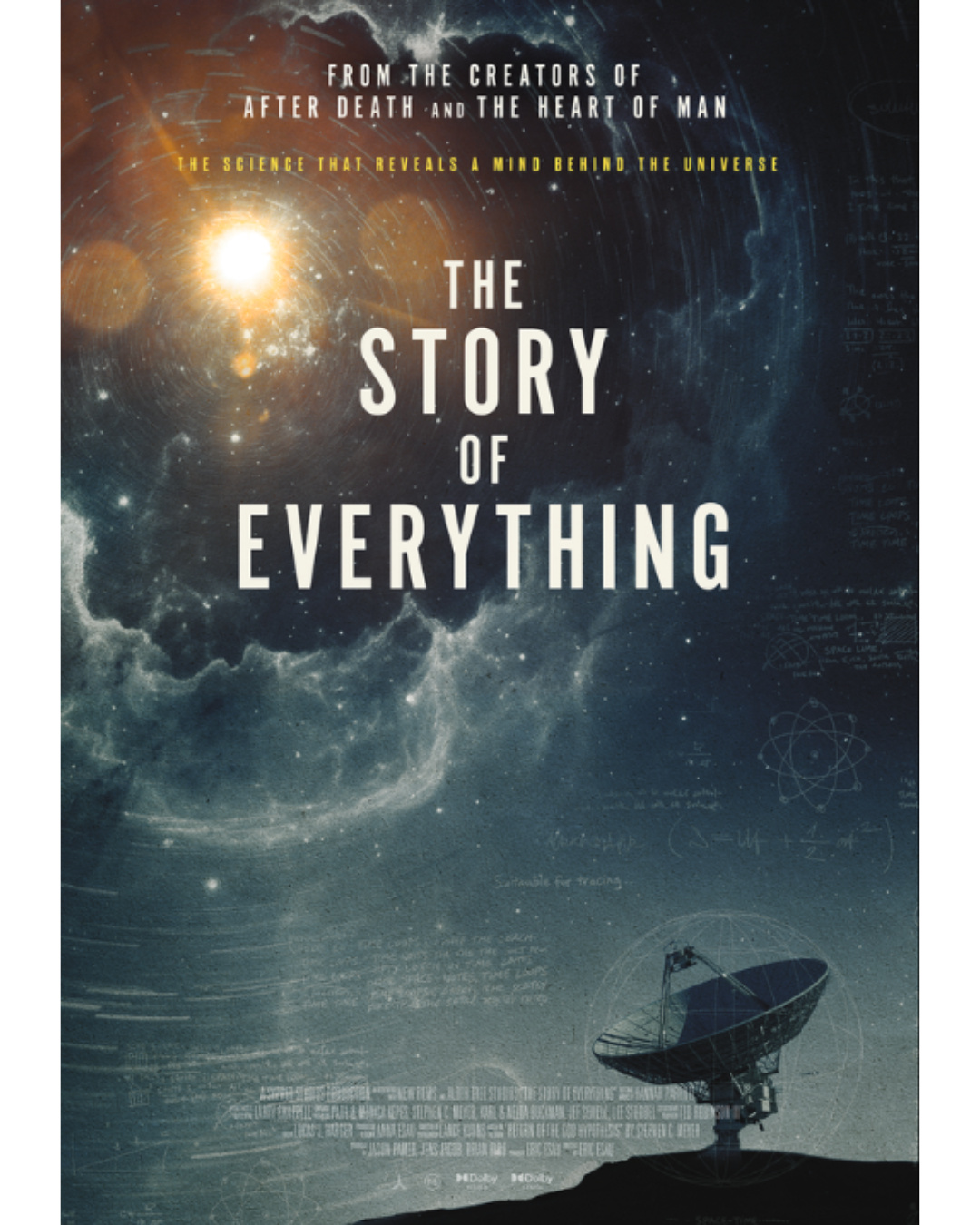
The Story of Everything is a deep exploration of critical questions all human beings must ask at some point in their lives. How did the world begin? Is there a super intelligent, all-powerful being outside of space and time? Unlike Saint Thomas Aquinas, the movie does not take a philosophical approach to the question. It takes the latest scientific research into the universe and studies of cells to present an overwhelming case for intelligent design.
An Ambitious Task
Even the title suggests that this is an ambitious undertaking. From the perspective of this non-scientific minded writer, the producers succeed on all counts, obliterating the materialistic theory of an eternal universe that proposes the world exists in a mindless, undirected way.
Simply put, the evidence of a designer makes sense.
Creators of this thought-provoking documentary use spectacular images of exploding stars, black holes, fiery nebulae, and a slam-dunk proof of intelligent design from a surprising source. I will tell you that plot twist subsequently.
The movie begins with a quote from Cicero from the year 44 BC:
The celestial order and beauty of the universe compel me to admit that there is some excellent eternal Being who deserves respect and homage.
A Battle of the Minds
Here we begin a battle of the minds. On one side are secular materialists such as astronomer Carl Sagan and on the other side are scientists including Isaac Newton, Johannes Kepler, and Robert Boyle who believed that the universe is a product of a pre-existing intelligence who has secrets to reveal in nature.
Carl Sagan held the bleak view that the world was a cosmic accident and is infinitely old. An interviewer asked him the big question: What is the meaning of life? He answered, “We are just mites on a plum. To believe otherwise is pathetic.”
As far as I know, Sagan never changed his opinion. The movie then turns to materialist scientists who had a paradigm shift and came to believe in intelligent design.
Among those scientists was Albert Einstein, famous for his theory of general relativity. For years, Einstein struggled with his equation that required a universe that was static, eternal and self-existing. He even created an arbitrary value to try to make the equation work.
Enter Father Georges Lemaître, known for the Big Bang theory that formulated an expanding universe made evident by red wave shifts and radiation in the universe. Both phenomena indicate a big bang at creation that caused an expanding universe.
In 1927, Father Lemaître and Einstein took a taxi ride together. The priest challenged Einstein’s theory that the world had no beginning. “I have evidence.” A short time later, Einstein accompanied Lemaître to view the red shift through the telescope. The famous scientist was convinced and called his theory of a static universe “the greatest blunder of my career.”
The movie continues to tell the story of one scientist after another publicly abandoning the concept of an infinitely old, static universe. Each story is told by artfully weaving together interviews with physicists and archival footage.
One of these scientists, Allan Sandage, stated that he came to the theistic view because of science. Astronomer and planetary physicist Robert Jastrow concurred, “No scientist wanted creation to have a beginning. Science took us there.”
From the Universe to the Cell
Narration now moves to the Goldilocks Universe. Here we learn of the fine-tuning of the universe. Everything must be just so, to a razor’s edge, for the world to exist. Countless examples are given of this fine tuning. My favorite of these is the fact that Jupiter and Saturn guard earth from destructive hits by blazing comets.
Switch now to the intricate design of the humble cell. Here is the slam dunk. Prior to the invention of high-tech microscopes, cells were thought to be globular goo packed inside the cells. No way. Cells are complex factories that baffle even the most brilliant computer geniuses.
Did you know these facts about flagellum bacteria? It swims about thanks to a miniature outboard motor with propeller, a tiny drive shaft with a total of 30 parts.
Through detailed animation, DNA molecules are on full display in their astounding double-helix design. DNA molecules store, transmit, and process information. I love the interviews with top computer scientists who shake their heads in amazement at the complex design that modern technology still cannot duplicate.
Now the film soars, rhapsodizing about the “gratuitous beauty” of our universe, irrelevant to survival. We see lovely images of a humpback whale, hummingbird, fish, snowflake, and a sea turtle.
Here is the “beauty principle”: The path to truth is through beauty. We need only to be willing to open that window.
I highly recommend this movie as truly groundbreaking. It would be an effective apologetics tool to launch high school and college students into critical discussions about the existence of God. It might even convince your atheist relative.
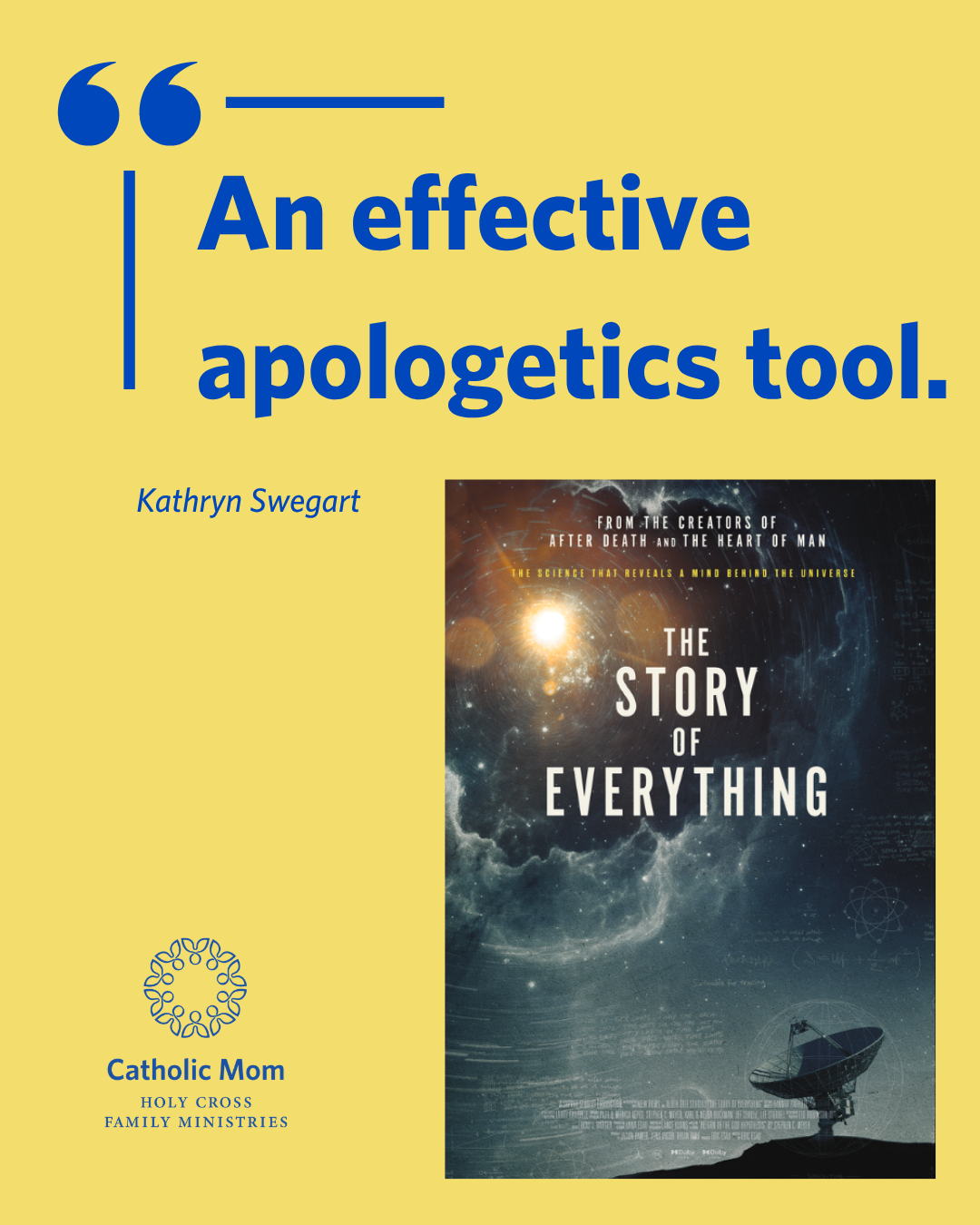
The Story of Everything opens in theaters on April 30, 2026. For tickets, trailer, and more information, visit TheStoryOfEverything.film.
Share your thoughts with the Catholic Mom community! You'll find the comment box below the author's bio and list of recommended articles.
Copyright 2026 Kathryn Swegart
Images: TheStoryOfEverything.com/film


About the Author


.png?width=1806&height=731&name=CatholicMom_hcfm_logo1_pos_871c_2728c%20(002).png "CatholicMom_hcfm_logo1_pos_871c_2728c (002)")


Comments