


Amanda Lawrence shares her experiences witnessing her son navigate his faith struggles.
The day after my son’s thirteenth birthday, we lost his father and stumbled into a whole new and unknown reality. There’s never a good time to lose a parent, but the day after becoming a teenager on the precipice of puberty may be one of the worst. God chose this particular cross for my son.
As his mother, it’s agonizing to watch, knowing there’s nothing I can do to help.
This often leads me to find solace in 1 Kings 17 with the story of the Widow of Zarephath. Before his encounter with her, Elijah had declared a drought in response to Ahab and Jezebel handing Israel over to false gods — a biblical no-no. Caught in the drought himself, the Lord commands him to go “to Zarephath of Sidon and stay.” At the end of his rope, Elijah knows he must trust in God’s Providence and obey.
As he arrives, God tells him to ask the Widow of Zarephath for water, and while she’s up, for some bread, too. Being an Old Testament prophet works up an appetite. Regardless, this is a bold move, given that she’s a widow and the brook Elijah lived by was just decimated by the dry spell. Once again, he trusts God will provide.
The widow informs Elijah she only has enough oil and flour for one more cake, and after that, she and her son will die. Elijah doesn’t seem bothered by her response. He knows God will come through. Meanwhile, I can’t help but laugh at her candor and wonder what dreadful things that woman endured to evoke such an answer.
I can only imagine.
Weeds Pretending to be Wheat
My son turned 21 this September. In the months leading up to his birthday, he admitted he was struggling with his faith. This broke my heart, but it didn’t surprise me. He had just spent the last eight years without a father, watching his mother struggle to keep her head above water. If more suffering is how God rewards his devout mother, he doesn’t want to participate in the faith. And I understand why.
The surrounding congregation has lived their whole lives listening to Christ’s words, which from his pew never seemed to take root. These are his role models, whether they know it or not. Meanwhile, God permits our strife to compound while those around us take exotic vacations or host elaborate parties. It doesn’t make sense to a young man who needs mentorship, compassion, and a supportive community to help him carry his cross.
One of the horrid examples I’ve encountered in my experience as a widow is a sentiment I’ve heard more than once; it goes something like: “If God wanted you or your son to be helped, you would be helped.”
Let’s unpack that. The person God placed before me to hear my pleas is the same person saying that God would help me if that were His will.
Interesting.
I cock my head and consider this. But doesn’t the Church consist of God’s hands and feet? Doesn’t God expect us to be the wheat among the weeds? These thoughts rumble around my skull as that person uses their free will to congratulate themselves and skulk off into the weeds. In doing this, they abandon whatever blessing awaited them had they chosen to flourish as wheat.
I imagine the Widow of Zarephath had similar experiences that caused her to give Elijah her devastating death-sentence answer. Fortunately, she recognizes the prophet as a divine messenger and becomes the wheat — despite having every reason to be the weeds. And so, she invites Elijah to eat the last of their rations. God rewards her with an endless supply of food to survive the drought. She’s our role model, and she’s not the only one.
All four Gospels recount the time Jesus instructed His disciples to feed the people, not send them away. With a few loaves of bread and some fish, God provides for the massive crowd, leaving them with leftovers. That’s how good He is when we cooperate.
I try to reinforce this for my son and remind him that when we offer God what little we have, He multiplies it. That said, I can never, not once, find the passage in Scripture where God says: “If I wanted to help you, I would.” That’s something the weeds say to strangle the wheat.
As you can probably tell, I spent much of the summer leading up to my son’s birthday praying with Matthew 13:36-43, where Jesus explains the parable of the weeds and the wheat. He tells us that the enemy’s task is to sow weeds among the wheat, quietly spoiling the harvest. Sadly, evil is the natural result. Surely knowing this information makes it easier to uproot the damaging seeds. Only that’s not what God wants.
God wants us to use our free will to choose to be the wheat among the weeds — the saints among the sinners — the Widow of Zarephath. If a destitute, ancient-world widow suffering through a drought can risk everything to be wheat and trust in God’s providence, what’s our excuse?
How Can We Lighten our Neighbor’s Burdens?
Just as the widow fed Elijah, God fed the crowd, and Simon helped Jesus carry His cross, we’re meant to bear other people’s burdens. We should seek opportunities to help, rather than send people away or rip up the flourishing weeds. We may never understand how they benefit the wheat, but they do. God permits both good and evil to coexist in our fallen world to bring about a greater good that goes beyond our puny human comprehension.
Sadly, sinners masquerading as saints most often represent us in society nowadays; the tempter ensures it. So what do I say to my faith-struggling son? The truth as I know it. Those particular parishioners are providing examples of how not to behave. It’s impossible to open one’s mind and heart to God’s word and remain selfish.
If after a lifetime of Mass, God’s word still hasn’t taken root in someone, pray for them. They were probably poorly catechized. Their seed fell on rocky ground, or among thorns. Don’t be like them. Cooperate with God. Jesus never asks us to give what we don’t have. He invites us to surrender the little we have into His hands.
Unfortunately, I can’t offer more sage advice on helping my son overcome his faith struggles because I haven’t. I’m not even sure that’s my task to accomplish. I invite him to participate more in the congregation and lead by example, and I’m proud to announce our priest recently commissioned him as a lector. Sure, he grumbled about it, but I truly believe his seeds of faith germinate in fertile soil. I ask him to cultivate those seeds every day, when it’s fun and especially when he doesn’t feel like it. And that goes for all of us laborers in God’s field working for His kingdom — hear God’s words, understand them, and bear their fruit.
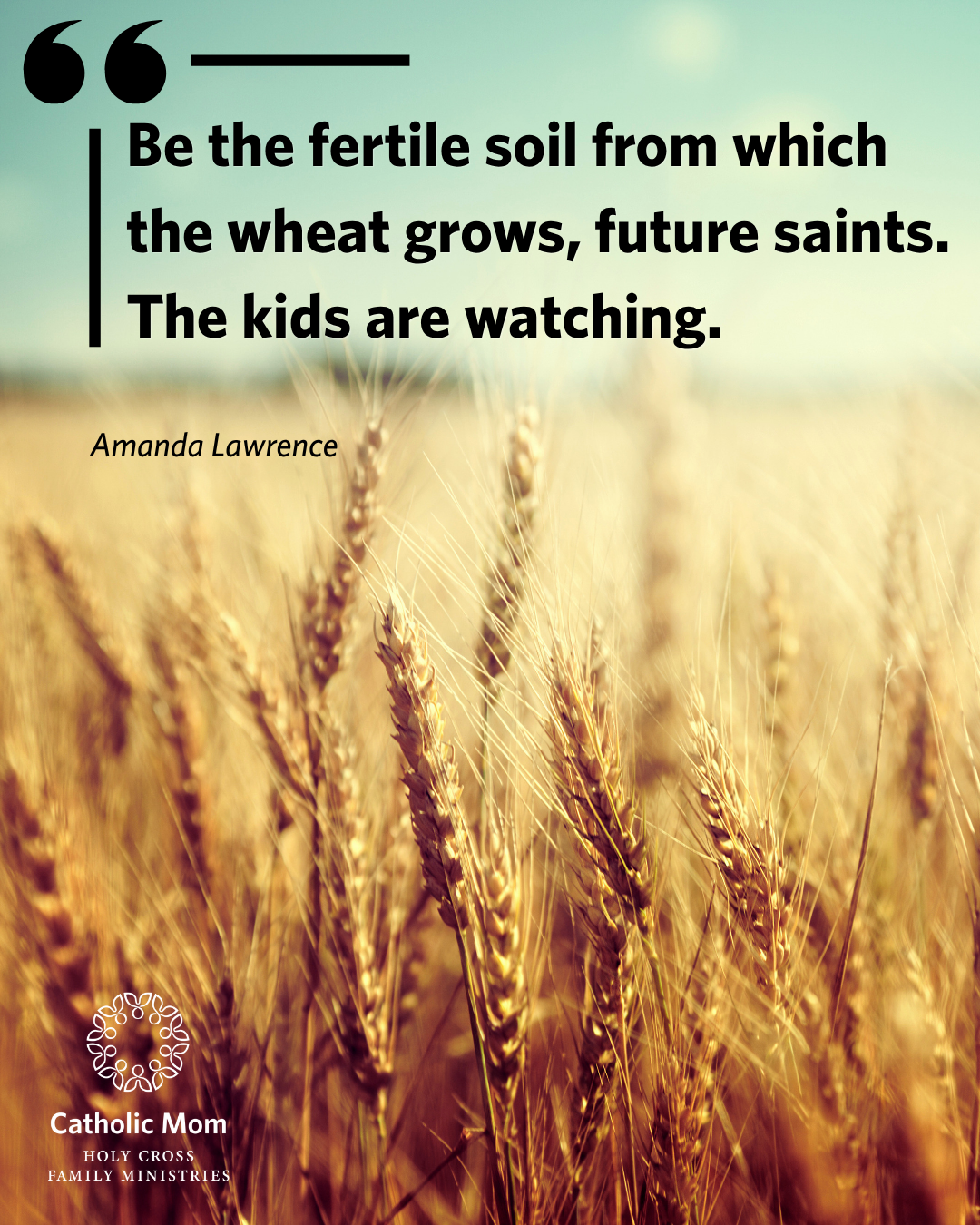
Be the fertile soil from which the wheat grows, future saints. The kids are watching.
Share your thoughts with the Catholic Mom community! You'll find the comment box below the author's bio and list of recommended articles.
Copyright 2026 Amanda Lawrence
Images: Canva


About the Author


.png?width=1806&height=731&name=CatholicMom_hcfm_logo1_pos_871c_2728c%20(002).png "CatholicMom_hcfm_logo1_pos_871c_2728c (002)")


Comments