


-1.png)
Liesl Schiavone sits in awe of the life of Saint Hildegard of Bingen, reflecting on how God calls each of us to use our unique gifts for the Kingdom.
The Life of Saint Hildegard
Saint Hildegard of Bingen was born in 1098 in Bockelheim, West Franconia (Germany), to noble parents. A mystic who experienced visions from as young as five years old, she was educated at a Benedictine cloister and took her vows at the age of fifteen. Hildegard was a composer, writer, and scientist, also known for her work in holistic healing and medicine. She became prioress at a young age, founded new convents, traveled frequently, evangelized in public settings, and used her gift of prophecy to record her visions.
In 2012, she was canonized and named one of the four female Doctors of the Church by Pope Benedict XVI. Many sources suggest that Hildegard struggled with chronic and recurring illness from a young age; she is recorded as recognizing these bouts of illness as instruction from God. Hildegard is an inspiring example of a woman who leaned into the gifts God had given her and used them to serve others with courage and faith.
St. Hildegard’s visions, 26 of which were compiled in her manuscript Scivias, often included light. She referred to this spiritual awareness as umbra viventis lucis, meaning “the reflection of the living Light.” Her visions frequently hearkened back to nature and natural revelation. In one excerpt, she writes:
And I am constantly fettered by sickness, and often in the grip of pain so intense that it threatens to kill me, but God has sustained me until now. The light which I see is not special, but it is far, far brighter than a cloud which carries the sun. I can measure neither height, nor length, nor breadth in it, and I call it ‘the reflection of the living Light.’ And as the sun, the moon, and the stars appear in water, so writings, sermons, virtues, and certain human actions take form for me and gleam. ("Hildegard of Bingen: Visions and Validation" by Barbara Newman, in Church History 54)
In addition to her visions, Saint Hildegard composed more than 77 musical arrangements featuring her lyric poems, collectively titled Symphonia armoniae celestium revelationum (“Symphony of the Harmony of Heavenly Revelations”). She wrote about the lives of the saints, authored two treatises on medicine and natural history, and maintained extensive correspondence in which she recorded prophecy. She also wrote a play and, for her own amusement, invented her own language and alphabet. Her brilliance was extraordinary.
Saint Hildegard as Patroness
Saint Hildegard initially seems an obvious patron for me; her love of music and writing mirrors my own interests and she is the patroness of composers and writers. Yet, despite this apparent similarity, this is truly the first time I have learned much about her life. I recall her name appearing in my college music history textbooks and perhaps encountering some of her works, but for reasons I cannot explain, my subconscious seems to have glossed over her.
As I have come to know her more fully, I feel as though I have been missing out, for she was undoubtedly an extraordinary woman. She appears to be someone who simply did the next thing she was called to do, responding faithfully to God’s will as it unfolded. She did her work quietly, initially intending to keep her visions to herself, but she responded to God’s call to share, create, lead, and serve. Gifted both spiritually and intellectually, she was ready to serve the Lord in whatever way He asked. Honestly, the sheer magnitude of those gifts hinted that relating to her might not be as simple as shared interests alone.
A Unique Part of the Body of Christ
During his papacy, Pope Benedict XVI spoke of Hildegard in his first two general audiences, saying,
Let us invoke the Holy Spirit, so that he may inspire in the Church holy and courageous women like Saint Hildegard of Bingen who, developing the gifts they have received from God, make their own special and valuable contribution to the spiritual development of our communities and the Church of our time.
Hildegard’s life stands as a striking example of what it looks like for a woman to receive extraordinary gifts and to trust that those gifts were given not for personal glory, but for the good of the Church. In a time when women were often unheard and uneducated, she nevertheless leaned fully into the abilities God had entrusted to her — intellectual, artistic, and spiritual — and allowed them to shape her vocation.
I expected to feel a deeper personal connection to Saint Hildegard, imagining myself as a musician and writer walking alongside her. Instead, the vastness of her accomplishments, her mysticism, intellect, and prophetic authority felt difficult to relate to. Yet perhaps that distance is precisely the invitation.
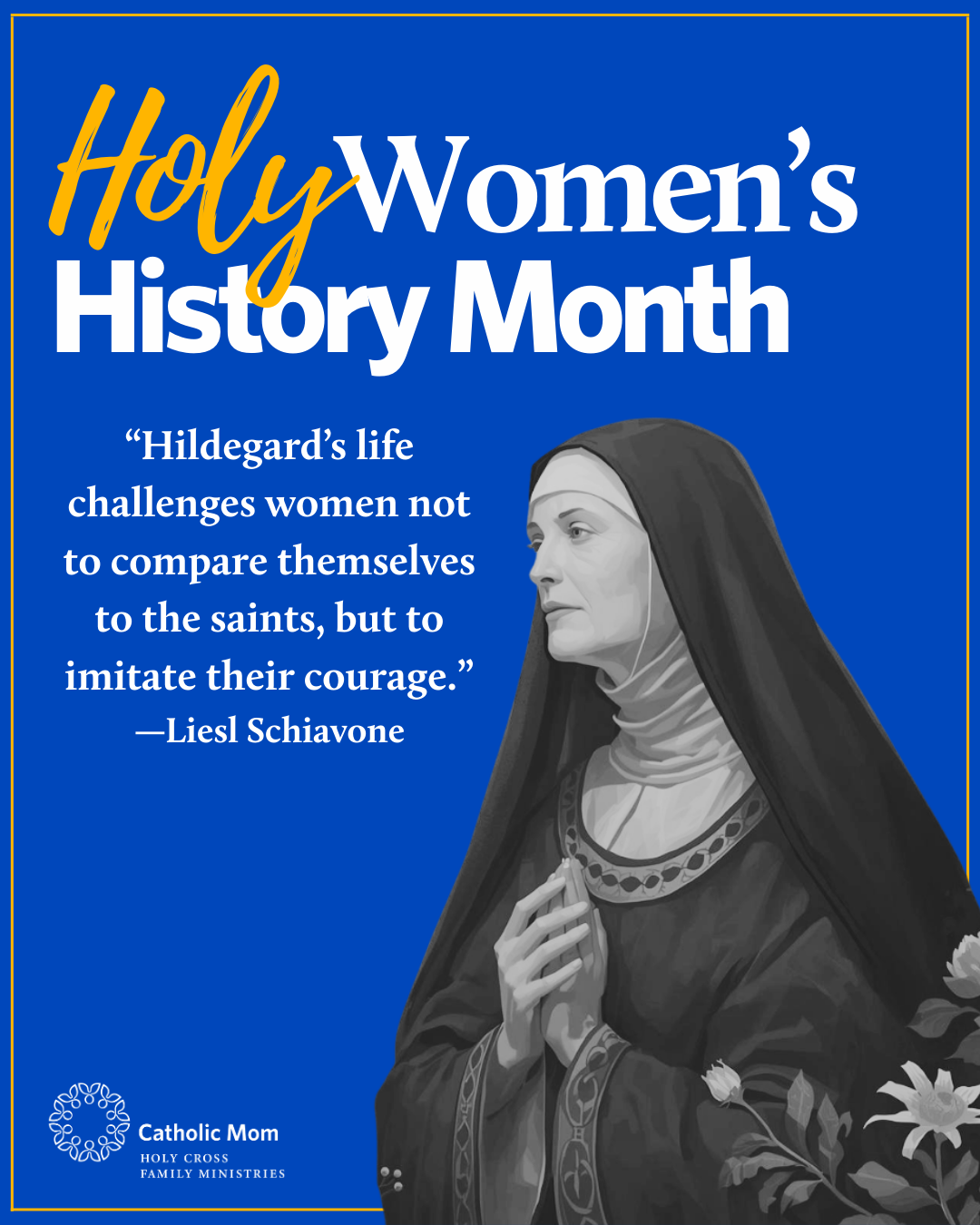
Hildegard’s life challenges women not to compare themselves to the saints, but to imitate their courage. She received extraordinary gifts and trusted that God intended to use them — not for personal glory, but for the good of the Church. Through her example, women are reminded that the Body of Christ is strengthened when we recognize, cultivate, and boldly offer our gifts in service. Not every saint must feel familiar to be transformative; some exist to stretch our sense of what faithful obedience can look like.
Saint Hildegard of Bingen, pray for us.
Read more of our Holy Women's History Month stories.

Share your thoughts with the Catholic Mom community! You'll find the comment box below the author's bio and list of recommended articles.
Copyright 2026 Liesl Schiavone
Images: (banner) Trinity Mirror / Mirrorpix / Alamy Stock Photo; Canva


About the Author


.png?width=1806&height=731&name=CatholicMom_hcfm_logo1_pos_871c_2728c%20(002).png "CatholicMom_hcfm_logo1_pos_871c_2728c (002)")


Comments