


Kevin Tondra looks at how we can help kids find contentment when the world is constantly pushing them to compare and compete.
During a fifth-grade Parish School of Religion class last year, we spent the evening exploring the Gospel story of the ten lepers: specifically, the reality that after being healed, only one returned to give thanks. I had exactly ten students that night. After our discussion and a follow-up activity, I handed out full-size Hershey bars.
Only one student said “thank you.”
My daughters — my faithful teaching assistants — still laugh with me about that evening. That moment has become a reminder of how easily we overlook the gifts God has already placed in front of us.
I’ve always loved a sentiment often credited to Piglet in the Winnie-the-Pooh stories: that even a very small heart can hold a surprisingly large amount of gratitude.
It's a gentle image, but it speaks to something I’ve seen time and again. Our kids are surrounded by messages telling them they'll be happy if they can just get a little more: more success, more recognition, more of whatever is trending on a screen. It's an exhausting way to grow up. I've watched that pressure take a toll on children, and it has convinced me that one of the greatest gifts we can give them is helping them discover that a grateful heart is already a full one.
Working with students has taught me that gratitude isn’t just a nice habit to practice. It shapes the way we see everything. For Catholics, gratitude begins with the understanding that life itself is a gift from God, something to be received before it is ever achieved. When we remember that, we stop measuring our lives by what we accomplish and start noticing what has already been given to us.
And that, I know, is the hardest part for our kids.
They are growing up in a world of constant comparison. They scroll through endless images that make everything look perfect, and it slowly shapes how they see themselves. They compare their grades, their athletic milestones, and even their own families to the lives they see on a screen. And over time, that kind of comparison narrows their vision until all they can see is what they lack.
Gratitude is the antidote. It pulls us back to what we actually have right in front of us.
Teaching Gratitude at Home
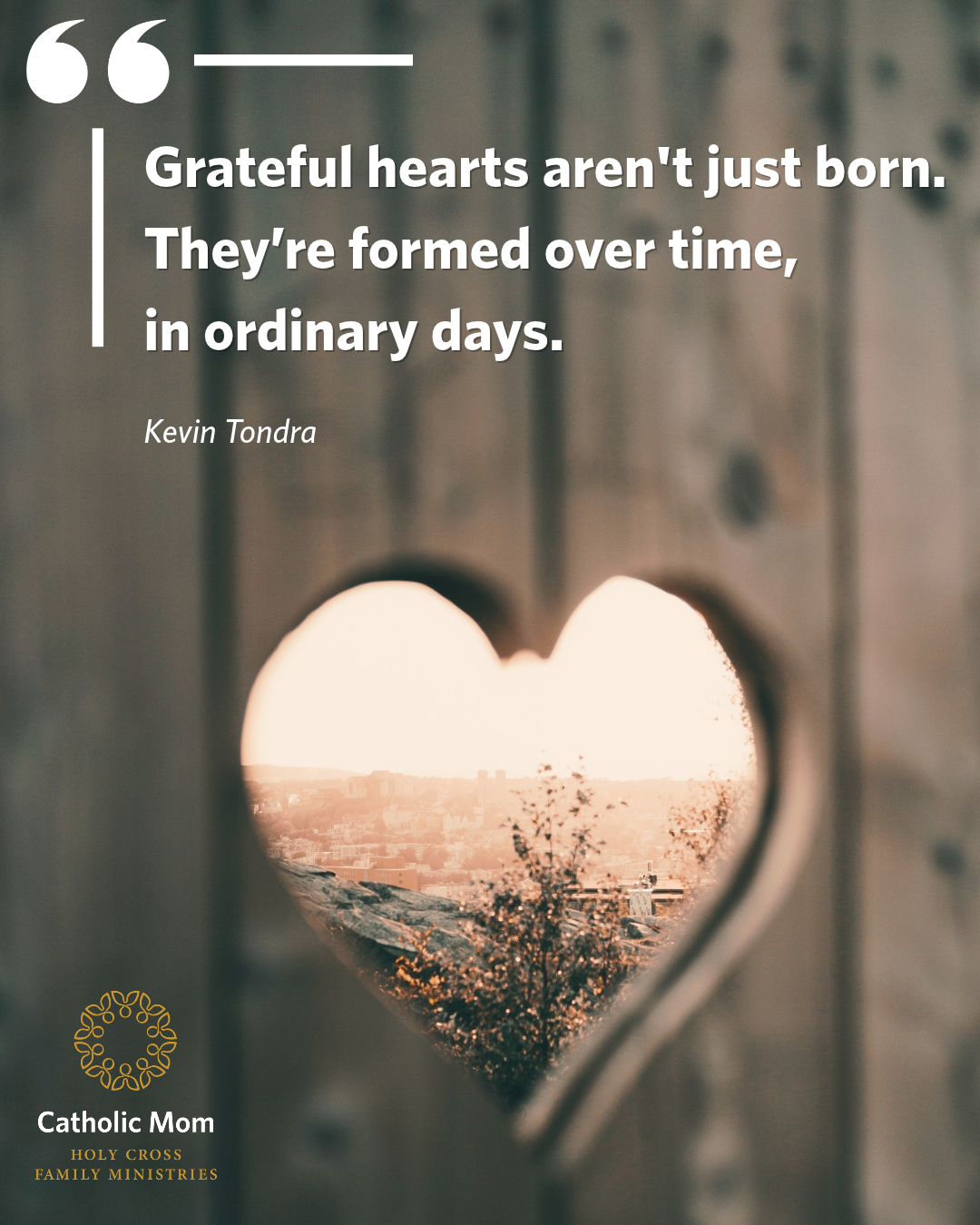
When my daughters, Marissa and Hannah, were growing up — and even now, as they navigate their own paths — I’ve tried to show them that gratitude is what helps you notice the people who support you. It's the teacher who believed in you, the coach who pushed you when you wanted to coast, the friend at a time of need who showed up without being asked, or simply sitting down together for a family dinner. I've learned that grateful hearts aren't just born. They’re formed over time, in ordinary days.
Over the years, I’ve realized my daughters pay far more attention to what I do than what I say. I don’t lecture them on gratitude. Instead, they hear me thank a neighbor for bringing our garbage bin back to the garage, or notice me pause for a quiet moment in the middle of a busy day. When they see me looking for the good, they start doing it, too.
Then there was our "bedtime audit." My wife started the habit of naming three things we were thankful for before turning out the lights. Some nights the answers were deep. Most nights they were simple: a good lunch or a funny moment. Over time, those small, repeated moments became the way we think. You start looking for your three things even on the days that feel long and difficult.
The hard days still count. I’m not suggesting we pretend life is all sunshine. My time at the University of Akron and in the classroom has shown me that disappointment is just part of life. My goal has always been to help my girls see that even on the days that feel unrelenting, there is usually a thread of grace if you’re willing to look for it. We talk about what we learned or who helped us get through it, rather than just focusing on the frustration itself.
I've also come to appreciate the power of a handwritten note. It sounds old-fashioned, but there is something about sitting down with pen and paper that slows you down and makes you think about the person behind what you received — whether a gift or simply their time. In a world where most of our gratitude is typed quickly and sent off in a matter of seconds, a handwritten note feels different. It carries weight. It lingers, even after the ink has dried.
Gratitude Turns Us Outward
The world gets bigger when kids learn to serve someone besides themselves. The fastest way to stop a child from worrying about what they don't have is to show them how they can help someone else. Whether it’s helping a neighbor or volunteering, it shifts the focus. It moves them from asking “What can I get?” to realizing, “What can I give?” and that is where they really start to see how much they have to offer. That, more than anything, is the kind of life we want for them.
I don't say this to suggest we ignore the hard stuff. Our kids are going to face loss and frustration. Gratitude isn't some mask we put on to act like everything is perfect. It’s more of a quiet confidence, the understanding that even when the seasons get tough, there’s still grace to be found.
I want to help the young people in my life — whether my own daughters or the students I’ve guided — move through the world with a sense of wonder, aware that they are held by people who care for them, and by a grace that’s bigger than any of us.
Even a very small heart can hold all of that.
Share your thoughts with the Catholic Mom community! You'll find the comment box below the author's bio and list of recommended articles.
Copyright 2026 Kevin Tondra
Images: Canva


About the Author



Comments