


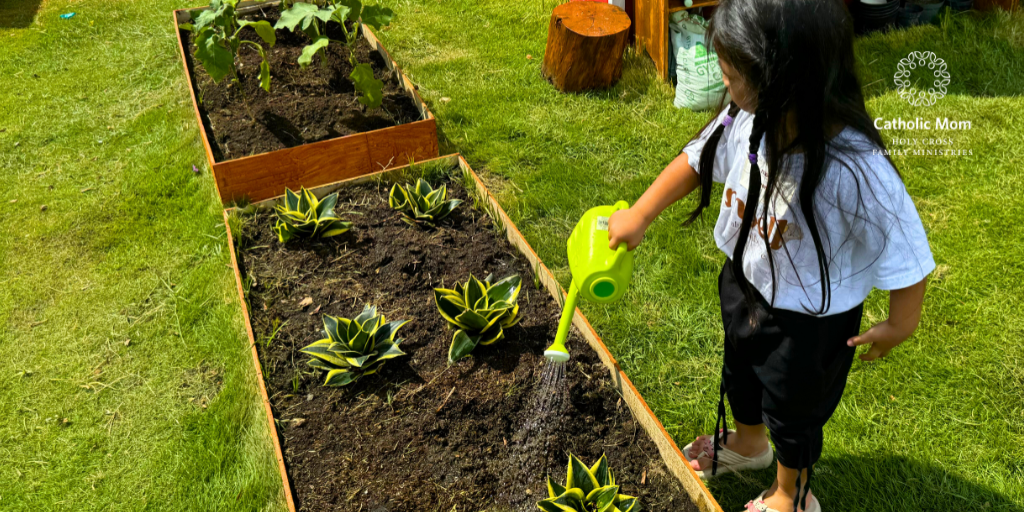
Samantha Stephenson shares five ways to integrate care for creation into your home, advocating for simplicity and sustainable living.
To be Catholic is to be sacramental — to believe that grace is not merely spiritual, but material. Bread becomes Body. Water gives new life. Oil seals our souls. And if God has chosen to move through matter, then matter matters. Creation matters.
And yet, we live in a throwaway culture that treats the earth as though it were disposable, something to be used up and replaced. Our homes are built for convenience, our meals come packaged in plastic, and our days unfold at speeds that leave no time to consider where our food comes from or where our waste goes.
But what if our family life bore the marks of a deeper reverence? What if our homes became places where creation was not consumed but tended — like the garden in which we were first placed, not as owners, but as stewards?
Sustainability, then, is not just about Catholic social teaching or Laudato Si’. It is about who we are. It is about receiving the world as a gift, holding it with tenderness, and teaching our children to do the same.
A Theology of Enough
Our culture runs on the fear of not having enough — so we hoard, we waste, we grasp. But in the garden of Eden, there was enough. There still is.
Living sustainably begins with the radical belief that God has given us what we need. It is a quiet rebellion against the myth of scarcity. It means choosing enough over more. A smaller wardrobe. A simpler meal. Reusable bags instead of endless plastic ones.
For the Catholic family, this is not minimalism for aesthetic purposes. It is liturgical. It is rooted in a reverence for the Giver and gratitude for the gift. Every decision to consume less, to reuse more, to repair instead of replace, becomes a kind of prayer — an act of thanksgiving.
The Home as First Monastery
Wendell Berry often speaks of the “household” as the unit of economy and morality. In our homes, values are not just taught; they are practiced. What we throw away, what we fix, what we plant: these habits form our children more than lectures do.
To live sustainably is to sanctify the ordinary. Baking bread, composting scraps, mending clothes, growing herbs in a windowsill — these are not insignificant acts. They are ways of slowing down, noticing, and living within limits.
Our homes become little monasteries where creation is honored, and the Creator is praised through daily rhythms of care.
The Garden as Catechism
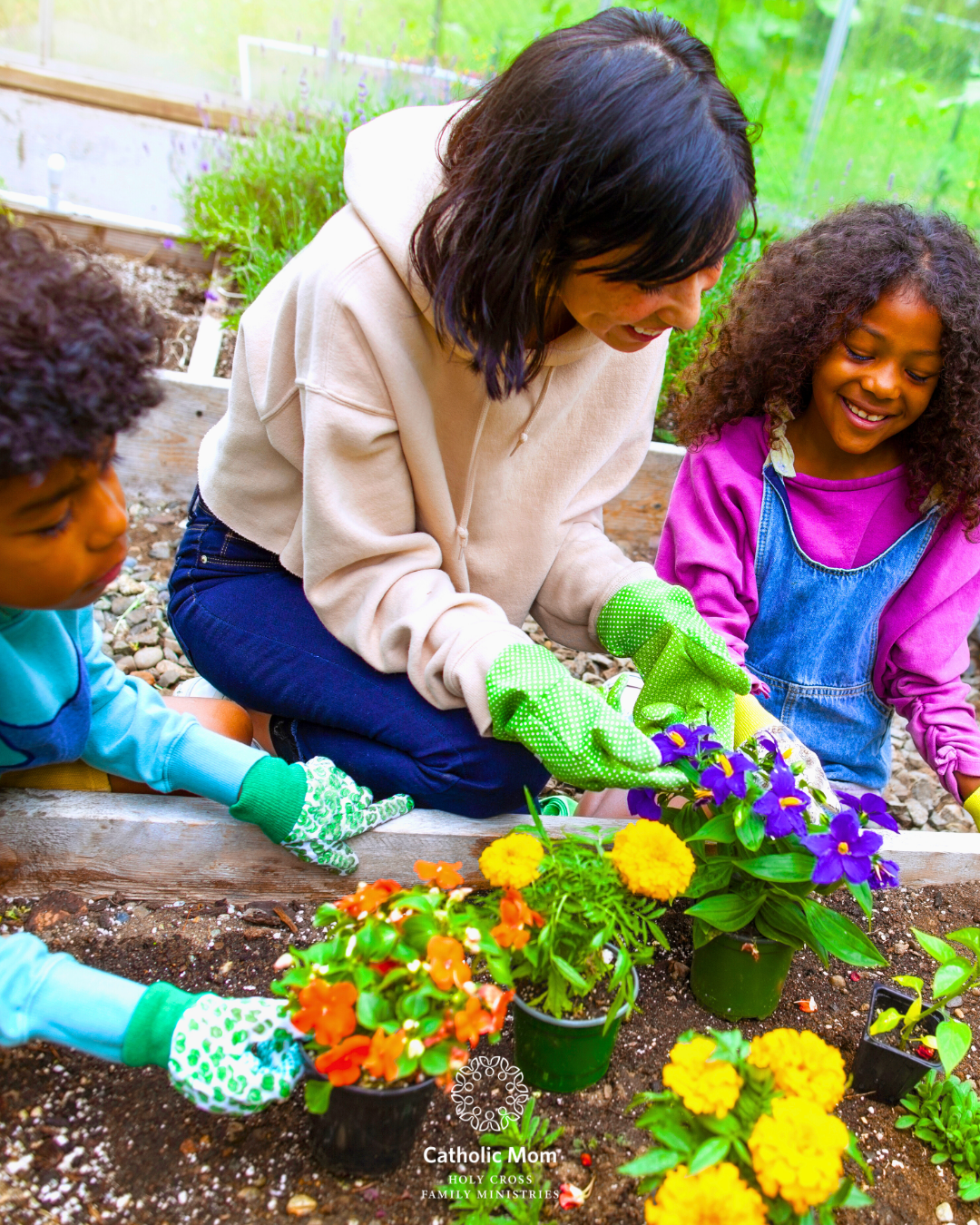
When children learn to grow food, they learn that life is slow, sacred, and dependent. They see that we are not the makers of life, only its stewards. They learn that carrots don’t come from plastic bags and eggs don’t appear from factories. They learn the virtue of patience, the theology of the seed, the mystery of transformation.
And in this work, we remember who we are: creatures made from dust, entrusted with the care of other creatures.
The garden becomes a living catechism: a place to teach about God not just through words, but through weeds and worms and wonder.
Why It Matters, Now More Than Ever
Creation is groaning. We see it in polluted rivers, in scorched forests, in skies choked with smoke. These are not just environmental crises. They are moral ones. Pope Francis reminds us that “the earth herself, burdened and laid waste, is among the most abandoned and maltreated of our poor.”
To care for creation is to care for the poor — because it is the poor who suffer most when ecosystems collapse, and it is our children who will inherit the consequences of our choices.
Sustainability is not just about avoiding guilt. It’s about choosing love. Love for the unborn, whose future we shape. Love for the elderly, whose traditions of thrift and care we recover. Love for our Creator, who walked in a garden in the cool of the evening and called it good.
Stewardship as Spiritual Practice
Stewardship is not just a moral obligation. It is a delight. A way of life that draws us closer to the rhythm of God’s grace.
When we line-dry our laundry, when we eat seasonally, when we choose glass over plastic — not perfectly, but intentionally — we are remembering that this world is not ours to dominate, but to tend. That nothing we own is truly ours. That every good thing is given for a time and meant to be returned in praise.
We are not building utopia. We are simply keeping watch. We are lighting small lamps against the dark, showing our children what it looks like to live gently on the land, faithfully in the home, joyfully in the Lord.
So we plant. We mend. We refuse waste. We choose local. We say no to fast and yes to faithful.
Not because we are trying to save the world, but because we have been given it — “good, very good” — and asked to tend it, not for ourselves alone, but for the ones who come after. For the One who made it.
Share your thoughts with the Catholic Mom community! You'll find the comment box below the author's bio and list of recommended articles.
Copyright 2026 Samantha Stephenson
Images: Canva


About the Author


.png?width=1806&height=731&name=CatholicMom_hcfm_logo1_pos_871c_2728c%20(002).png "CatholicMom_hcfm_logo1_pos_871c_2728c (002)")


Comments