



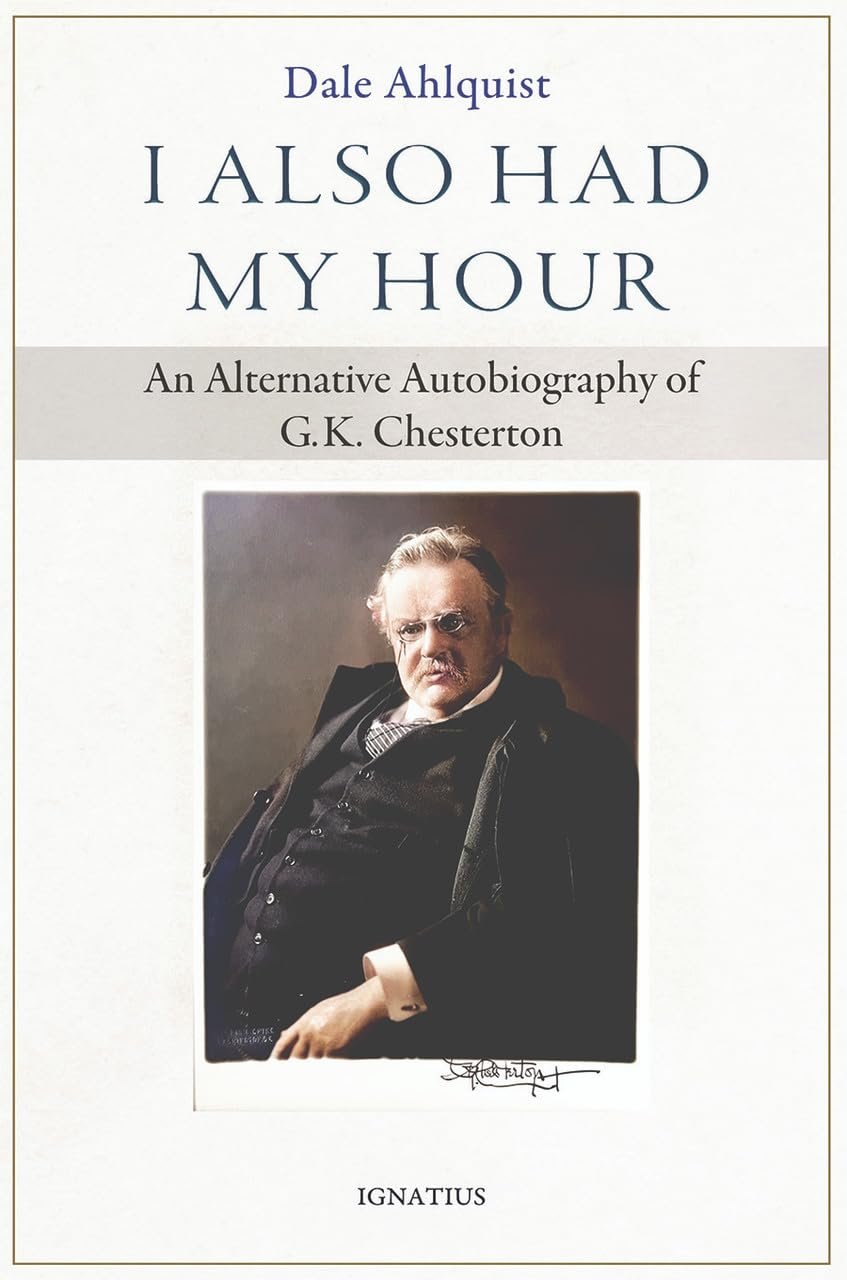
Michael Astfalk Jr. reviews Dale Ahlquist’s alternative autobiography of G. K. Chesterton.
I Also Had My Hour: An Alternative Autobiography of G.K. Chesterton
By Dale Ahlquist
Published by Ignatius Press
If there is one man who is impossible to sum up in a single book, it must be the quizzical figure of Gilbert Keith Chesterton (GKC). If there is one book that is impossible to sum up in a single review, it must be I Also Had My Hour: An Alternative Autobiography of G.K. Chesterton by Dale Ahlquist. G.K. Chesterton (for the sake of conciseness I will refer to him as GKC as Ahlquist does in the book) was a well-renowned journalist and author living from 1874 to 1938. GKC actively wrote and commented on politics, religion, and culture while advocating for adherence to Christian traditions, recognition of human dignity and rights in free government, and ardently advocating for the Catholic Church to which he converted in 1922.
My first introduction to GKC was the Father Brown Mystery “The Blue Cross” in my sophomore year of college. I knew almost nothing of him then though, and I did not revisit him until this past summer. I began listening to an audiobook of What’s Wrong with the World, and from then on, I like to think I have developed a certain intoxication for GKC’s common sense. In addition to What’s Wrong with the World, I have read The Innocence of Father Brown, Heretics, and What I Saw in America.
With the exception of the Father Brown mysteries, these books primarily pertain to GKC’s political thought. However, they are all steeped in his religious understanding of the world. I have, unfortunately, not yet read some of GKC’s most well-renowned works such as Orthodoxy and The Everlasting Man, and I am very much new to GKC’s life and works.
Taking Mr. Ahlquist at his word, GKC wrote very little directly about himself, even in his autobiography. When GKC does write about himself, it is usually in some form of humble, jovial, self-deprecation, often in the form of a fat joke (GKC was internationally famous for being an extraordinarily large man). Mr. Ahlquist also points out that despite the fact that GKC is most famous for his Father Brown mysteries and his books, his primary occupation was that of a journalist and a speaker and that, “It is as a daily writer that he earns his bread” (16).
Even GKC’s most renowned book, Orthodoxy, is really akin to a collection of essays. Despite being some of GKC’s most important works, Ahlquist points out that they have been left by the wayside in the popular understanding of GKC. The author therefore sets out to induce from oft-overlooked journals, articles, and speeches what it might be like to meet and talk to GKC.
A Novel-Style Autobiography
The book is written almost entirely through a blend of GKC’s own writing. I was at first worried that the book might become a Frankenstein’s monster of hideously mismatched sentences leaping from article to article, but I am happy to say that Mr. Ahlquist uses his talents to weave together a book that reads as if GKC had penned it from heaven, wistfully giving a final “farewell for now” from the other side of the pearly gates.
It is both difficult and easy to sum up GKC. Mr. Ahlquist ultimately seeks to convey that GKC loved God and so intimately and passionately loved the world and people that God has gifted to us. While a simple axiom, this also simply fails to convey the depth with which GKC lived and loved. Everything GKC does sounds so extraordinary but really should be ordinary. It is secretly obvious. He is the crusader of common sense, and we could certainly use another crusade for common sense. One could implore the pope to declare such a crusade, although the attempt would be needless, for GKC already declared one during his lifetime.
The book can be divided into a couple of different groups of chapters. The most prominent of these sections are the sketches of GKC’s life. A chronology at the beginning of the book provides a reference to GKC’s life events year-by-year as well as many fascinating quotes and stories. Other chapters tie together excerpts from GKC’s articles that loosely follow the events of his life or seek to convey some of the beliefs and practices that GKC held to be important or influential on his life.
The book never takes a traditional biographical approach, which focuses on prying out the minute details of one’s life, for GKC states, “The real objection to it [biography] will rather be found in the fact that it reveals about a man the precise points which are unimportant” (141). Instead, Ahlquist searches for GKC’s soul much more in the vein of what Catholic writer Joseph Pearce attempts to do in his own biographies.
Other chapters take on different tones as Ahlquist guides us towards different focuses of GKC’s life. Ahlquist shifts our view towards GKC’s relationship with Hillaire Belloc (termed the “Chesterbelloc”) and the influence that they had on each other’s political and religious beliefs. A few chapters are devoted to writings from others describing their experiences with GKC. Ahlquist also spends some time addressing GKC’s critics, as well as accusations that GKC was anti-Semitic, entirely using GKC’s own writings.
One chapter in particular, which was perhaps one of my favorites, provides a smorgasbord of GKC’s poetry. Prior to reading the book, I was unaware of GKC’s poetic skills, and I am still dumbfounded at GKC’s reported ability to write quality poetry extemporaneously. GKC found writing poetry to be one of the great pleasures of life, and the poems arranged by Mr. Ahlquist convey some of GKC’s inner thoughts and feelings, ranging from the depression that he struggled with during his college years, to the awe and wonder of the world that he felt intensely in his older age. Given my own ignorance of poetical form and meter, I would have perhaps appreciated some light analysis in this chapter to assist my reading.
Finally, some of Ahlquist’s last chapters focus specifically on GKC’s thoughts on religious dogmas. These are certainly the chapters that I will need to reread the most. GKC here attacks the postmodern dogmas (or perhaps more accurately, the lack of concrete postmodern dogmas) and the value of Catholic doctrine. What I found particularly interesting here was GKC’s philosophy of mysticism.
Even Death’s Sting Could Not Still the Pen of the Knight of the Holy Ghost
I Also Had My Hour is the ideal summary of the life, character, works, and significance of GKC for those unfamiliar with him. I imagine it also serves as a refreshing personal examination of him for his experts. Catholics, in particular, may find encouragement in treading down the paths GKC charted for his readers, introducing them to new theories, perspectives, and resources on the faith.
GKC had a magical way of describing something that is really obvious in a way that sounds extraordinarily profound. I have tried to describe some of GKC’s arguments to family and friends, and as the words cascade out of my mouth haphazardly, I feel that I am describing something that we really already know, but never thought about. GKC faced many of the problems being faced today, and in studying his arguments, one can see more and more that the social and political problems Catholics are facing today were putting down roots in GKC’s day. Though the problems may have grown worse, I find an inversely equal solace in GKC’s wit, jollity, attacks, and advice.
GKC was utterly in love with life because he was just plainly in love with God. Even GKC’s most vicious attacks stemmed from an intense love of others. I think that the best way I could sum up GKC’s character based on his presentation in the book would be this: He had the body of a troll, the intellect of an angel, and the soul of a little boy.
.png?width=1080&height=1350&name=20251204%20GUEST%202%20(1).png)
Ask for I Also Had My Hour: An Alternative Autobiography of G.K. Chesterton at your local Catholic bookseller, or order online from Amazon.com or the publisher, Ignatius Press.
Is this a book you'd like to read? Share your thoughts with the Catholic Mom community! You'll find the comment box below the author's bio and list of recommended articles.
Copyright 2025 Michael Astfalk, Jr.
Images: Canva
Michael Astfalk, Jr. is a recent graduate of St. Vincent College in Latrobe, Pennsylvania, working in the IT industry. Because he loves learning, he has ambitious reading goals and enjoys classic literature and medieval and American history, especially regarding the American Civil War.


About the Author


.png?width=1806&height=731&name=CatholicMom_hcfm_logo1_pos_871c_2728c%20(002).png "CatholicMom_hcfm_logo1_pos_871c_2728c (002)")


Comments