


Sarah Pedrozo reflects on the lessons learned from a newly discovered children’s book by Don Freeman and his son, Roy.
My family and I have recently gone through some pretty big changes. My husband and I just moved out of the city, away from the home where we raised our five children for the last 20 years. We left the suburbs for a small farmstead, which is much closer to my husband’s work, tucked away in a small college town. With the move, I officially retired from 20 years of parish ministry, another big change.
My 88-year-old mother has also just moved out of the house she lived in for 25 years, the house where she watched all the grandchildren grow up. She’s adjusting to a new life, too, dividing her time between her adult children and her new retirement community.
Three of my kids have moved overseas, and the other two are busy building their lives. I’m pleased to speak often to the ones who are far away, as well as spending time with the two who are still near. But that doesn’t stop me from missing them, or our old life together, just the same.
Now as October begins, even nature is changing. Change. Change. Change. It’s everywhere I look, and, quite frankly, it feels overwhelming. I pray to be saved from being like Lot’s wife, who turned and looked back on her old life and became a pillar of salt, or like the Israelites, who complained that God had brought them into the desert only to watch them die. “At least we had food and shelter in Egypt,” they complained. Change, especially big, life-altering change, is hard to navigate, even if it’s good change.
One More Acorn
As I was unpacking yet another box of books, I came across the children’s book One More Acorn, by Don Freeman (the author of Corduroy). I paused from the unpacking and took a few minutes to read it. I’m glad I did. During the writing of this book, Freeman had also encountered change.
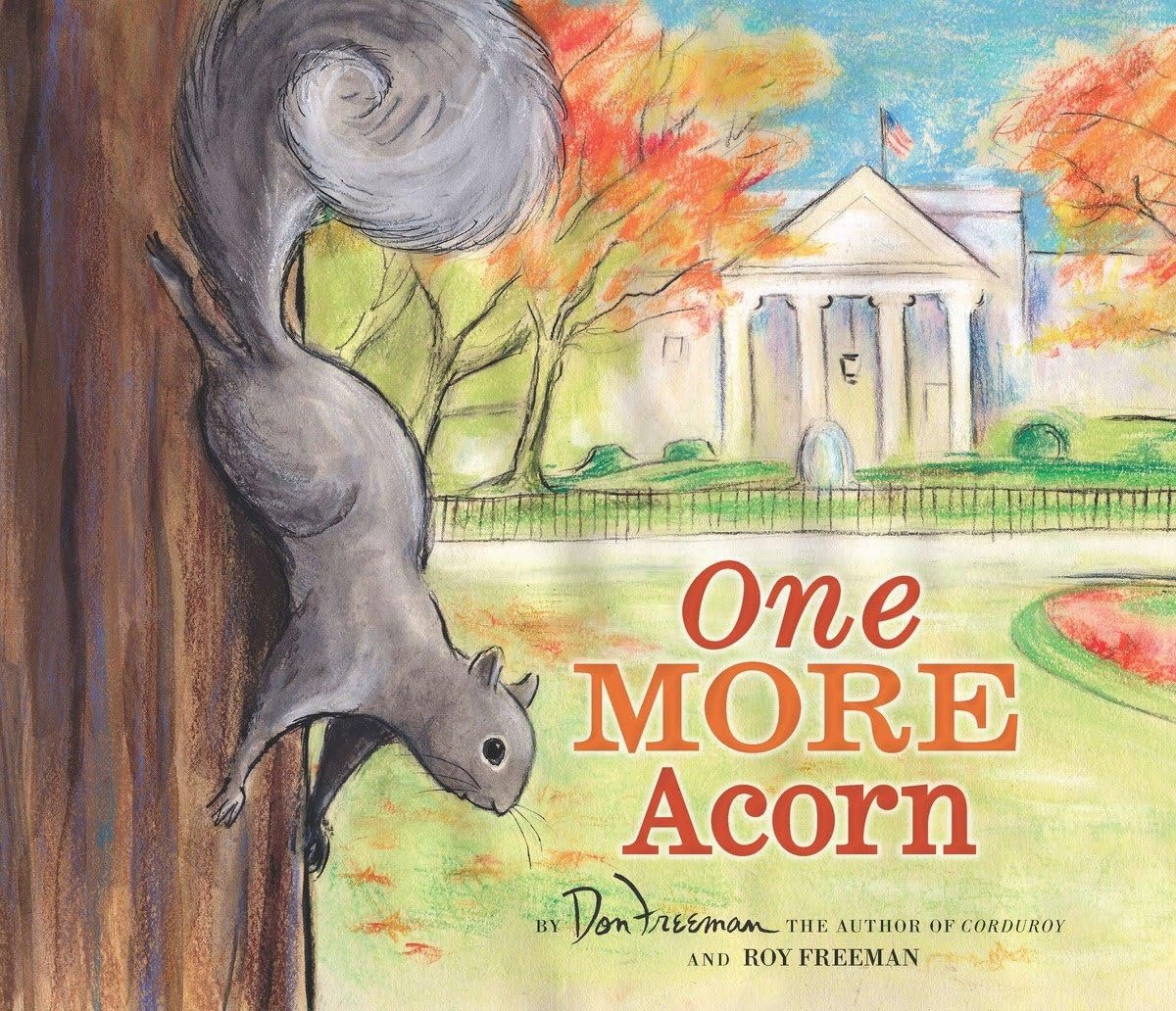
The book records the movements of “a lively gray squirrel named Earl,” who lives in a tree with his family in Washington D.C. One morning, as Earl stands at the door of his tree house, he sniffs the air, looks at the leaves, and realizes that winter is on its way. It is time to collect the acorns he had carefully hidden during the summer.
He runs out to Layfette Square, already covered in a “light layer of leaves.” Earl scratches and sniffs, and finds several acorns, which he dutifully stuffs into his cheeks and stores back in his home in the tree.
But as the day goes on, Earl pauses. He remembers hiding one great, big acorn during the summer, but he doesn’t remember where he put it. Suddenly, it comes to him — he hid it across the street, across the big wide avenue running past the White House.
Earl draws near to the avenue but finds that “the street was filled with cars and trucks and people riding bikes.” He notices that people are hanging up flags, and it seems to be a special day." How will he make it across safely?
He dashes across the street “in a flash,” arriving safely on the other side, then heads straight for the Washington Monument. In the park surrounding the Monument, Earl finds he is not the only one there. He notices many boys and girls, also digging in the ground, on a school field trip. “Maybe they are looking for acorns, too,” Earl thinks.
Just then, one of the boys points to a huge acorn: Earl’s acorn! Earl races over, and the boy, noticing the small gray squirrel sitting with his tail twitching asks, “Do you want this acorn? You can have it!”
The class of children move back onto the bus, and Earl, big acorn securely stowed, races back to cross over the wide avenue. But now the street is lined with lots and lots of people. There’s a parade happening. How will Earl ever cross back?
Scanning the situation up high in a tree, Earl sees the solution. He recognizes the boy who helped him earlier. He is standing, waving on the side of the avenue. With a hop, hop, hop, Earl jumps on the boy and his classmates, using their heads and arms like stepping stones. He arrives safely at the other side of the street and delivers the one big acorn to his family. They are safe for the winter.
Historical Note
There is one more aspect of this children’s book to note. Don Freeman began work on it in the fall of 1963, when he was sent to D.C. to cover the Senate hearings on the Civil Rights Bill. As was his habit, he carried his sketchbook with him and wrote back to his family in California that he was working on a new story about a squirrel collecting acorns “under the colorful fall leaves on the grass.” Freeman thought it would be his most beautiful book yet.
But a tragic event got in the way. On November 22, 1963, President John F. Kennedy was assassinated. Freeman was so devastated by this event that he never finished the story of Earl and the big acorn. That fell to his son, Roy, who inherited all of his father’s sketchbooks and unpublished works. Working with a publisher and an illustrator, Roy finished and published One More Acorn in 2010.
Lessons Learned
So why did this simple little book about a squirrel resonate with me? Because it pointed out several things that I had forgotten, in the midst of my sea of change.
First of all, there’s a time for everything. Although Don Freeman started this book nearly 50 years before it was published, it was his son who saw it through. Like the changing of the seasons that Earl notices, I have to recognize that I am in a new season now, too. Just as Don could not have foreseen the events that took place shortly after his visit, I can’t see the future. I don’t know what these next years will bring, only God does. But I have to trust that He will see me through.
Secondly, Earl is in a specific place. Readers will recognize the places named: Layfette Plaza, the White House, the Washington Monument. The story doesn’t talk about ‘anyplace,’ it mentions ‘this’ place. Our lives are like that, too. We don’t live ‘anywhere’, we live ‘here,’ in this time and this place with these people. We each have problems and challenges specific to our own lives. But if we keep watching and praying, sort of like Earl did, God will provide the way through our dilemmas. I have to believe that God will show me the path forward, as long as I stay close to Him.
Finally, and maybe most importantly, the one big acorn reminds me of Jesus’ parables about the pearl of great price and the lost coin. Seeking the will of God, building His kingdom here on earth, is really all that matters. If I can remember that old adage each day — to see Him more clearly, love Him more dearly, follow Him more nearly — then I’m doing the one thing that is necessary.
As Michelle Nott wrote in Welcoming Fall, change is hard but “God designed our life to be full of seasons, and each one brings different forms of beauty.” Perhaps Saint John Henry Newman put it best when he wrote, “To live is to change, and to become perfect is to have changed often” (An Essay on the Development of Christian Doctrine). Help me, dear Lord, to change into the person you call me to be during this new season of my life.
Share your thoughts with the Catholic Mom community! You'll find the comment box below the author's bio and list of recommended articles.
Copyright 2026 Sarah Predrozo
Images: Canva
This article contains Amazon affiliate links, which provide a small compensation to the author of this piece when purchases are made through the links, at no cost to you. Thank you for supporting our Catholic Mom writers in this way.


About the Author

.png?width=1806&height=731&name=CatholicMom_hcfm_logo1_pos_871c_2728c%20(002).png "CatholicMom_hcfm_logo1_pos_871c_2728c (002)")


Comments