



Katie Flodder discusses how the story of the Visitation reveals practical guidance for moms helping their teens seek holy friendship.
Watching our pre-teens and teens navigate the social jungle can bring us right back to those awkward junior high days. We felt awkward in our own skin and questioned every interaction with our peers. So, when our children are rejected or are on the receiving end of cruel behavior, we feel it pierce our hearts just as keenly. There is no bigger empath than a mom when it comes to her kids.
Further complicating teen friendship is the fact that Gen Z and Gen Alpha are spending less time practicing social interaction face-to-face. In a February 2024 article in The Atlantic titled “Why Americans Suddenly Stopped Hanging Out,” Derek Thompson parsed through data collected by U.S. Bureau of Labor Statistics (BLS) from 2003 to 2022 to uncover face-to-face socializing among teenagers fell by more than 45 percent. It’s no wonder teens struggle with friendships.
Yet, this isn’t a hopeless situation and, like anything in life, it just needs Jesus. His Mother is an example to us and a study of the Visitation narrative (Luke 1:39-45) reveals qualities to emulate when seeking friendship. Not only that, but the Visitation gives us a jumping off point for talking to our teens about friendship.
Keep Christ at the Center
Elizabeth and Mary’s joy is linked by God. They are coming together to celebrate the good works of the Lord. They pray together and encourage one another to keep their eyes fixed on God. Perfection isn’t the goal; it’s about encouraging each other to practice the habit of turning toward the Lord.
Delight in One Another
When Mary and Elizabeth first greeted each other, the joy is palpable. I could see them sprinting toward each other and jumping up and down shrieking with delight while embracing each other tightly. These two clearly adore each other and their personalities are compatible. At this point in life, moms have been around the block a time or two in friendship and we know that not everyone clicks and that’s OK. We can help teach our kids to grow in the skill of knowing when a friendship isn’t a good match.
No posse? Not a problem.
Renowned child psychologist Lisa Damour reports that kids with just one or two good friends are generally happier. Teens don’t need to buy into the narrative that they need a horde of friends. If your teen has found one or two close positive friendships, we can encourage gratitude and discourage comparing group sizes with their peers. The goal is quality, not quantity.
Kick Jealousy and Competition to the Curb
Elizabeth’s first words to Elizabeth upon greeting her are of life-giving celebration: “Most blessed are you among women, and blessed is the fruit of your womb" (Luke 1:42). Success is not a candy bar: 5 pieces for the other kid and only 1 left over for you. There is more than enough to go around.
Girls can be especially prone to comparison, and social media throws fuel on that fire. As women, we’ve all seen relationships torn apart by jealousy. This friendship pitfall is especially hard to root out and takes ongoing conversations over the turbulent teen years. The root cause of jealousy is the belief that we are the ones lacking so it causes us to operate from a place of feeling less than. When we operate in that space, others successes feel threatening or as if they’re pointing a big flashing sign on our perceived inadequacies. We can teach our kids to identify this feeling and to allow it serve as a reminder that we need to go to prayer and meditate on the qualities God has intentionally knit into each of them.
Cultivate Grace for Each Other
Mary is quite literally full of grace and a Mother to us, and we see that throughout Scripture and from the accounts of the saints. Our friends will mess up and they’ll hurt us. These teens are in the throes of major brain development and constantly fluctuating hormones and at the same time are trying to learn how to be good friends. If our kids cut every friendship off at the first sign that someone will disappoint them, they may turn up with a posse of zero.
We can help our kids cultivate grace for their friends' shortcomings and how to work through friendship disappointments. At the same time, not everyone is in a place to be a healthy friend. It’s important to help teens discern when it’s prudent to give a friend another chance and when it’s best to move on.
Be the Friend You Want to Have
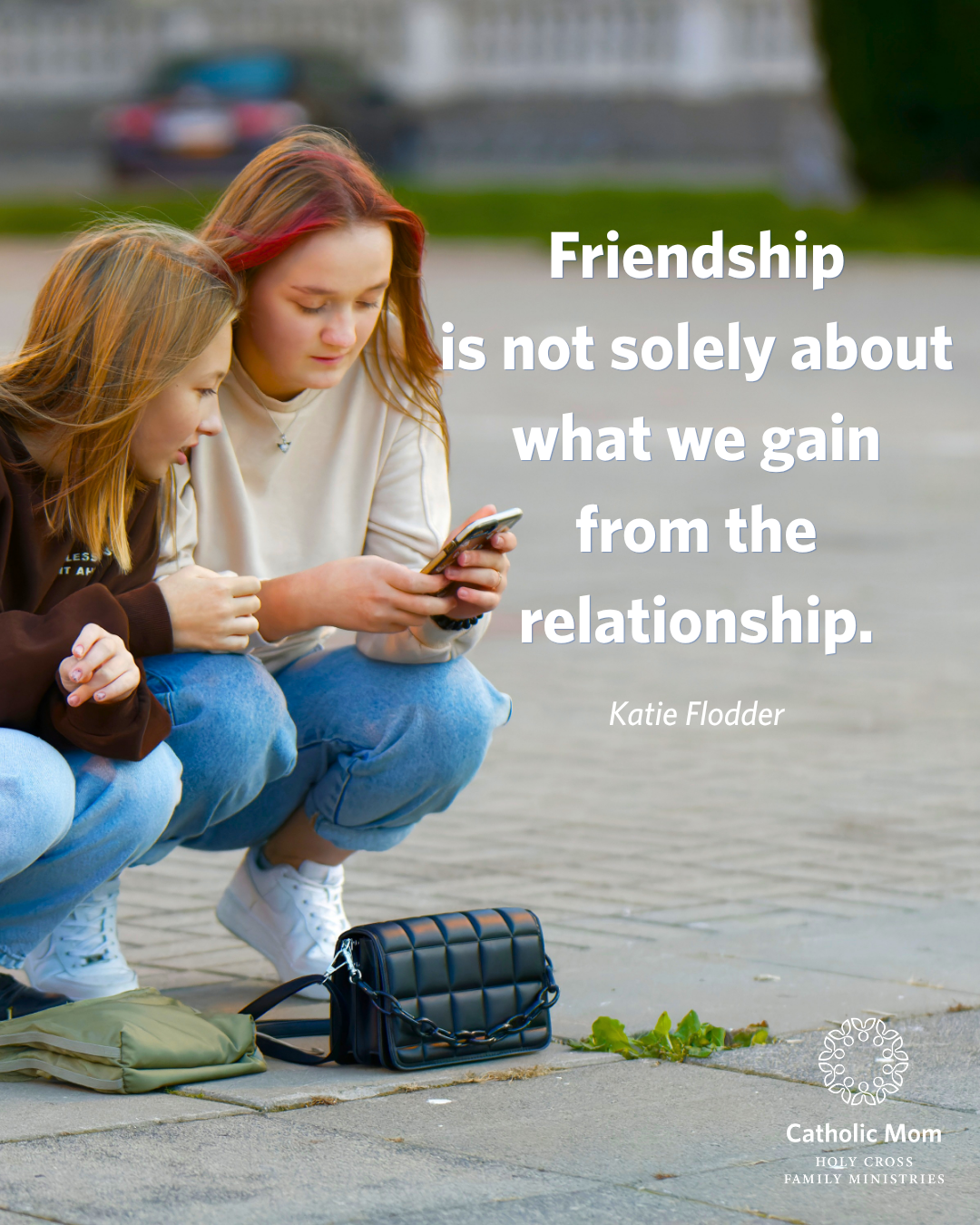
All the qualities we’ve talked about are the makings of a loving and Christ-following friend. Friends like these are one of life’s greatest gifts. However, friendship is not solely about what we gain from the relationship. We have to ask our kids: Are they exemplifying these qualities in return? Are they acting in a way that attracts these types of holy friendships?

Contemplate the Visitation with Your Teen
Find a quiet moment with your teen and meditate on the Visitation together. I’d recommend a time when you can spend at least 20 intentional minutes together. To sweeten the deal, you can make it special — grab some chips and salsa and sit on the patio together. My daughter and I sneak away to a local coffee shop and find a place tucked away in the corner.
- Before reading the Visitation story, ask you teen to be thinking about the qualities of friendship they hear as you move through the narrative.
- Read the Visitation story with your teen (ideally 2 or 3 times).
- Set a timer and quietly journal your own impressions of the qualities of friendship you heard, and anything else that God brings to your heart.
- Share what the Lord revealed to each of you and discuss. Mommas, we want to suppress the need to lecture and instead get curious about their responses and ask follow-up questions.
- Above all, enjoy each other’s company!
Share your thoughts with the Catholic Mom community! You'll find the comment box below the author's bio and list of recommended articles.
Copyright 2026 Katie Flodder
Images: Canva


About the Author


.png?width=1806&height=731&name=CatholicMom_hcfm_logo1_pos_871c_2728c%20(002).png "CatholicMom_hcfm_logo1_pos_871c_2728c (002)")


Comments