



Maria Morera Johnson reflects on the powerful impact of living with a grateful heart, even when — perhaps especially when — it is difficult to do so.
Thanksgiving is right around the corner, and with it comes the usual increase in gratitude posts and memes on social media. I’ve seen a fair share of silly and even cynical posts through the years around this holiday, but my algorithm is going to deliver plenty of heartwarming videos, and I’m sure to shed a tear or two.
November became a de facto month of gratitude. In fact, it has formally been the Month of Gratitude since 2016. When you consider how many downright dumb celebratory months we’ve named, having a month dedicated to gratitude is a very good thing indeed. But what does this really mean? And why should we be expressing gratitude?
Expressing Gratitude Is Good for Us
One of the things that fascinates me about the Catholic faith is how science corroborates so many of the practices we take for granted in living our faith. One of those practices at the top of the list is expressing gratitude. We thank God for big things and small things, and many things in between. Recent studies in neuroscience and psychology suggest that gratitude influences not just the mind, but the body and the spiritual life. Living in gratitude impacts how we process good and bad events in our lives, regulate our emotions and stress, and manage our relationships.
Mainstream secular culture would have us believe this is a new discovery, but as Christians we’ve known this for centuries. Throughout Scripture, gratitude is more than a response to good fortune; it is a way of recognizing God's presence, remembering His faithfulness, and trusting in His goodness, especially when we don’t see it in the midst of trials or challenges. We are called to give thanks for what we receive, through our worship and prayer, and how we love others. Before the popularity of gratitude journals in pop psychology, Scripture expounded on the theme of gratitude. There are so many instances of gratitude in the Bible that it would be impractical to name them all.
The Psalms are filled with gratitude, but my favorite is Psalm 103:
Bless the Lord, my soul; all my being, bless his holy name! Bless the Lord, my soul; and do not forget all his gifts, Who pardons all your sins, and heals all your ills, Who redeems your life from the pit, and crowns you with mercy and compassion, Who fills your days with good things, so your youth is renewed like the eagle’s. (Psalm 103:1-5)
In Luke 17:11–19, we hear the story of the ten lepers healed by Christ, and how only one returns to thank Him. We recognize ourselves in these men, reveling in the gift and forgetting the Giver. Taking a moment to pause and reflect on the gift gives God the glory.
Finally, perhaps the best-known reference to gratitude in Scripture is from Saint Paul’s first letter to the Thessalonians:
Rejoice always. Pray without ceasing. In all circumstances give thanks, for this is the will of God for you in Christ Jesus. (1 Thessalonians:16-18)
Saint Paul encourages us to rejoice always, pray without ceasing, and give thanks in all circumstances. I have prayed with this particular passage too many times to count. I’ve often wondered what it means to rejoice, which is not the same as happiness. Pondered how one could possibly pray without ceasing. And perhaps most difficult of all, to give thanks in all circumstances. Reframing this as an invitation to remain grounded in God’s love despite the difficulties of life changes everything for me.
Give Thanks in All Things
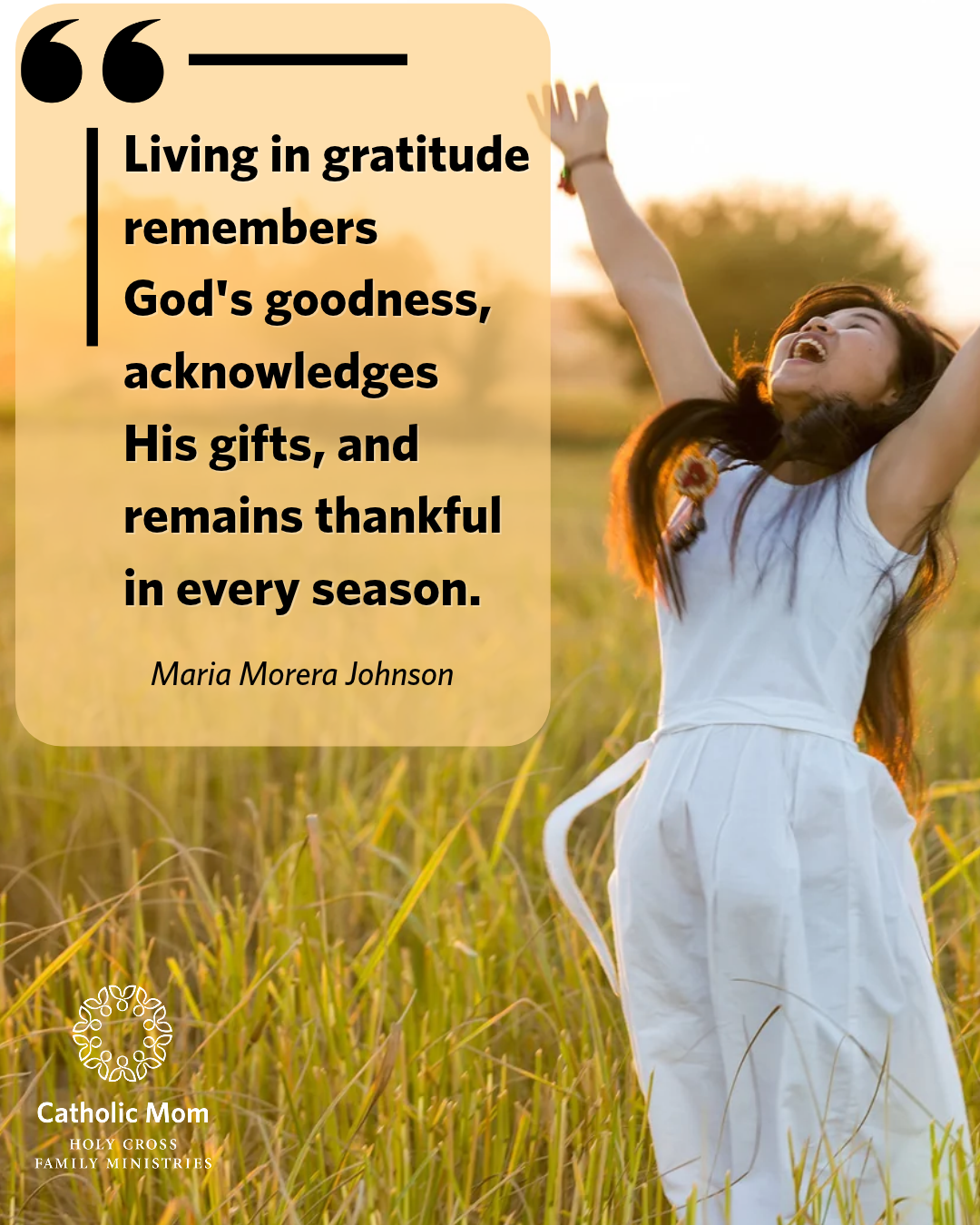
Gratitude for the good things in life comes easily for us. It is quite another thing to face loss, fear, or uncertainty with gratitude, and yet, these are also opportunities to draw closer to God. Living in gratitude remembers God's goodness, acknowledges His gifts, and remains thankful in every season. I’m a work in progress, practicing this daily with mixed results. That, too, is perhaps part of the process of not only growing in gratitude, but growing in our love of God.
Many, many years ago, I encountered the “grateful tweet” in a charming social media post by Matt Swaim, host of The SonRise Morning Show. Matt’s concept was fun: give thanks in your very first post of the day. More often than not, it was about simple joys such as a hot cup of coffee or a sweet hug from a child. The unexpected outcome for me was developing the habit of giving thanks first thing in the morning.
At first, my grateful tweets were for the little joys in my life. Eventually, it included bigger, less tangible but more meaningful thanks. By the time the public practice of this fun social post had fallen away, I had developed a strong spiritual practice that evolved into something more when a heartbreaking illness changed the course of my life. By then, I had learned how to give thanks in all things. I could do without the illness, but I could not do without the God who has been present throughout it. “In all circumstances give thanks.”

The practice of living in gratitude acknowledges that our life is a gift. When we understand that it is more than a feeling, it is a relationship with Christ, then we truly begin to understand what it means to be a Eucharistic people. We receive; we give thanks; we go out into the world to take this gift of Christ to others.
Share your thoughts with the Catholic Mom community! You'll find the comment box below the author's bio and list of recommended articles.
Copyright 2026 Maria Morera Johnson
Images: Canva


About the Author



Comments