



Johanna Stamps discusses how resilience builds a path toward dealing with grief into the lives of large families.
As a single mom of an only child, I can’t help being fascinated by the families in our community with eight or more children. There is such a stark contrast between my own child’s existence and that of someone born into a massive family. I’ll be the first to admit that my only child gets the luxury — and the burden — of my undivided attention. By contrast, a child in a large family has to share the spotlight immediately, which naturally introduces them to the hard truths of the world.
Over the years, I’ve noticed that large families naturally instill certain mindsets that offer lifelong benefits to children, especially when they face major losses and transitions.
The Family Classroom
In a large family, crucial life lessons are learned at a remarkably young age:
- You will not always get what you want.
- Sometimes you need to make sacrifices for the collective good.
- Life is not fair.
When framed positively, these experiences equip young people for the severity of the real world. Their family becomes a microcosm of life's actual realities. It is almost as if the large family serves as a classroom for navigating loss and transition:
- They notice siblings as they grow, develop, and change.
- They watch family members move through changing living situations.
- They experience the sting of others moving away.
- They accept that day-to-day plans will be upended by the needs of the group.
By contrast, so many of us walk through life with an artificial sense of total control. The plans we make usually pan out. Our friends are always there. Our faith traditions remain unmoved, and our spiritual leaders stay with us for decades. We can easily go years, if not decades, without experiencing a devastating loss.
The Illusion of Our Master Plan
As we move into our university and professional years, control often becomes the ultimate goal: “I’m targeting X amount in my 401(k). I will have this many children before 40. I will become a partner in my firm by 45.”
If you grew up in an environment where you always received what you desired, it is a massive shock when life suddenly deviates from the script: when you're diagnosed with melanoma at 39, fail to find the spouse you dreamed of, struggle with infertility, or lose a family member to an unexpected tragedy.
“This isn’t the way it’s supposed to be!”
Grief shakes you to the core, fracturing the foundation of your existence. If that core is built entirely on control, the reality of loss feels like a 7.7 magnitude earthquake.
We might even use our own faith to reinforce this flawed idea, telling ourselves: “Surely, if I stay close to God, my plans will be blessed and I’ll get my heart’s desire.”
When we expect to be in control, we are severely blindsided when life looks dramatically different than we anticipated. To avoid the uncontrollable pain of grief, we often try to force control elsewhere, distracting ourselves from the experience entirely.
Ironically, even in our academic explanations of grief (like the Five Stages), we try to control the outcome by neatly categorizing our symptoms. We desperately want a nice, linear, predictable plan for escaping the pain.
Choosing Flexibility Over Control
But what happens when control is no longer the goal?
This is the dramatic difference I notice between my single-mom existence and that of my large-family counterparts. I have my little handwritten schedule for the day with two to four moving parts, and it usually chugs along without a hitch. The moment something goes off the rails, I feel a spike of anxiety.
When my friends with large families make plans, however, they automatically leave room for unexpected disruptions. They plan less rigidly because the likelihood of a derailment is simply too high. They expect the unexpected and build flexibility — true breathing room — into a life they never assume will go exactly as designed.

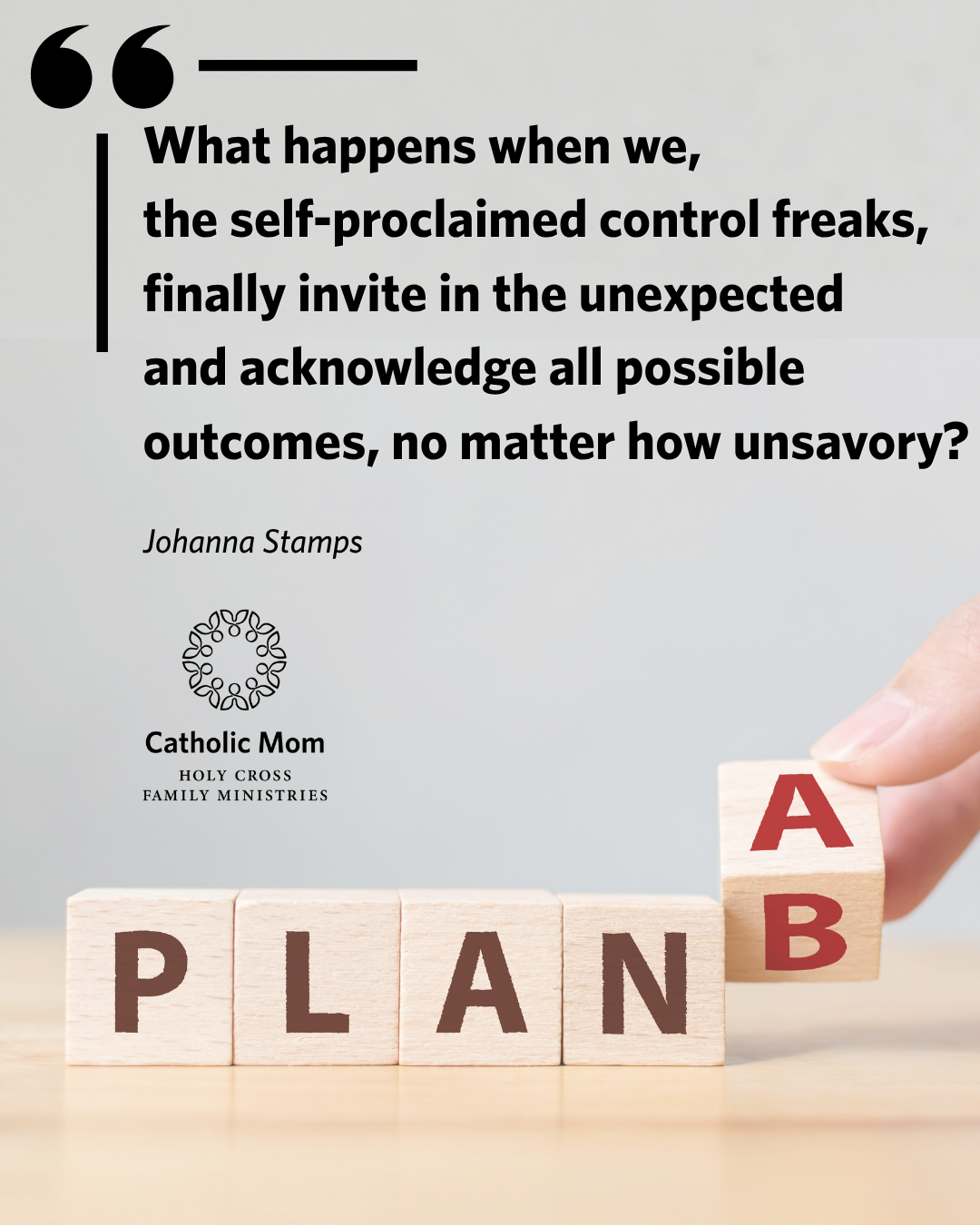
What happens when we, the self-proclaimed control freaks, finally invite in the unexpected and acknowledge all possible outcomes, no matter how unsavory? What happens when we embrace the shifts and quietly whisper to ourselves, "Life is not fair"?
When we are able to do this, we finally learn to appreciate exactly what is in front of us. We begin to see life as it truly is, instead of constantly trying to dictate a master plan that could easily be blown up tomorrow or by 3:00 PM today.
The same is true for how we navigate major loss or transition. When we hold space for the tension between the life we desire and the life we actually have, we find ourselves firmly grounded in reality. We are no longer easily blindsided by life’s upheaval, and we learn to navigate through the pain instead of becoming paralyzed by the anxiety of losing control.
Share your thoughts with the Catholic Mom community! You'll find the comment box below the author's bio and list of recommended articles.
Copyright 2026 Johanna Stamps
Images: Canva


About the Author

.png?width=1806&height=731&name=CatholicMom_hcfm_logo1_pos_871c_2728c%20(002).png "CatholicMom_hcfm_logo1_pos_871c_2728c (002)")


Comments