


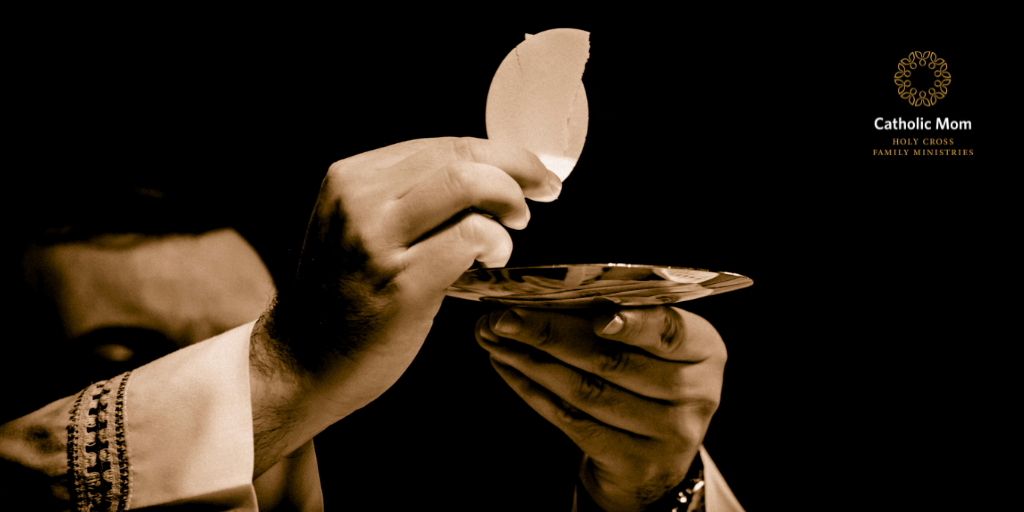
Sherry Hayes-Peirce shares what she has learned about receiving the Eucharist from the teachings of the saint the Church celebrates today.
Today we celebrate the Feast of Saint Cyril of Jerusalem. For most of my life, this feast held little meaning for me. However, since I returned to college last fall to pursue a master’s degree in theology, I have learned that he played a pivotal role in determining how the Eucharist should be received. I learned that the practice of receiving Communion in the hand dates back to 348-350 A.D., as noted by Saint Cyril of Jerusalem.
The exact direction is outlined as follows: “Make your left hand a throne beneath your right, then receive, taking care that nothing is lost.” This comes from Saint Cyril’s Mystagogical Catecheses, lecture 23. This remained the practice until the medieval period, around the 9th century, with the emergence of the Latin Rite, when receiving the Eucharist on the tongue began.

A Changing Practice
The reason for the shift was to ensure that the Eucharist was consumed in the presence of the priest, and, much like Saint Cyril’s original directive, “than nothing is lost,” the use of a paten in a kneeling stance of reverence emerged.
Then, in the 1960s, the practice of receiving the Eucharist in the hand was restored as the norm. The General Instruction of the Roman Missal (GIRM 160) states that a communicant may receive the Eucharist in either the hand or the tongue, but it also references an outdated practice of using a paten, which was used when kneeling was the norm, rather than the current practice of standing. The acceptance of both clearly reflects the validity of both practices.
I was fascinated to learn the history of how the faithful have received Communion through the centuries. It seems that history shows that our Church continues to change over time and will continue to grow and adapt to the universality of its members.
As we move through the Lenten season, my studies on the Eucharist are particularly meaningful. Following the story of the Last Supper, the original Eucharistic celebration was so powerful. The early Christians had to celebrate in private homes until 313 A.D., when practicing Christianity became legal. The centuries since have seen our prayer practices evolve into the one we celebrate at the Masses we attend today, which has created a desire to read more about the origins of the source and summit of our faith.
A Call to Leave Behind the Labels
As a 61-year-old woman who attended both Catholic elementary and high school. I was catechized to receive Communion on the hand, and up until the Covid-19 pandemic, I only remember seeing one family at my parish of 30 years receive the Eucharist on the tongue.
After we emerged from the pandemic shutdown, more people began to want to receive the Eucharist on the tongue. I don’t really care how one receives, but my heart is heavy that this has become a fracture in the faith community.
I write this in an effort to have us pray on the Feast of Saint Cyril of Jerusalem to respect one another’s choices in the reception of our Lord. Let us not label one another based on the decisions we make, but, as St. Cyril suggests, offer prayers to the Holy Spirit, as in his Mystagogical Catecheses:
Then we call upon God, the lover of mankind, to send forth the Holy Spirit upon the gifts lying before Him, that He may make the bread the Body of Christ and the wine the Blood of Christ; for whatever the Holy Spirit touches is sanctified and transformed.
Let us seek to be transformed by receiving the Body and the Precious Blood of Jesus and not stand in judgment of our brothers and sisters in the same Christ for how it is received.
Glory be to the Father, the Son, and the Holy Spirit.
Saint Cyril, Pray for us!
Share your thoughts with the Catholic Mom community! You'll find the comment box below the author's bio and list of recommended articles.
Copyright 2026 Sherry Hayes-Peirce
Images: Canva


About the Author


.png?width=1806&height=731&name=CatholicMom_hcfm_logo1_pos_871c_2728c%20(002).png "CatholicMom_hcfm_logo1_pos_871c_2728c (002)")


Comments