



Laura Vazquez Santos reflects on finding God in suffering and spiritual desolation, discovering that even our darkest seasons can become companionship with Christ.
Desolation Is Not Abandonment
The feeling that God is silent or distant is one of the most frightening spiritual experiences a soul can have, especially for someone who has been faithful and who has tried to do everything right. I’ve personally walked through seasons of what Saint John of the Cross so beautifully described in his writings on the “dark night,” and I found myself there again — right in the thick of one of the most trying chapters of my life as a parent and woman, beginning this past Lent and continuing even now.
I’ve learned that when clarity fades and the feeling of consolation disappears (while the trials remain in full force), it becomes easy to feel abandoned. I’ll admit, like so many before me, I struggled to understand it; being forced instead into a quieter posture of faith and having to accept that much of how God works, and His timing, remains a mystery.
But this season has also reinforced a truth: desolation is not evidence of God’s absence. Great saints and mystics like Saint John of the Cross, Saint Thérèse of Lisieux, Saint Pius of Pietrelcina (Padre Pio), and others walked through profound spiritual darkness. It can have a purpose, even though it is deeply difficult to endure.
God is present in the silence even when He cannot be felt. And this kind of desolation, which so many of us endure, can refine us and temper us like metal in fire, forming a deeper kind of faith rather than one built upon fleeting consolation. Instead, the faith forged in fire becomes one rooted in the steady truth of who God is.
The Body and the Soul Are Not Separate
This year has been hard in our home. Chronic illness has worsened, at times to the point of being unbearable. There has been physical exhaustion alongside emotional suffering, grief, and the weight of surgical preparation and logistical stress. To say it has been difficult to persevere in faith would be an understatement. And while I recognize that these are not spiritual weaknesses, but rather part of the cross we have been asked to carry in this season, they have made being faithful (and modeling that faith for our children) harder than usual.
I share this because I know that, as a mom, I am not alone. So many of us are parenting while already stretched thin carrying illness, stress at work, financial pressures, family worries, sleepless nights, and responsibilities that do not disappear simply because we have reached our limit.
Eventually, discouragement settles in and despair can feel dangerously close. But suffering does not get the final word.
As my body has felt depleted in these seasons, (affecting everything from prayer and concentration to emotional resilience and even the ability to feel consolation at all) I’ve had to remind myself that this is not a moral failure. It is an invitation in real-time to surrender more fully and rely upon God’s providence.
And while women, in particular, are sometimes made to feel that their physical or emotional suffering somehow diminishes their spiritual credibility, I have learned that when offered to the Lord, even the body’s weakness can become a quiet participation in Christ’s Passion, not a disqualification from it.
Sometimes, We Are Asked to Sit in Gethsemane
Perhaps this is why I have found myself returning repeatedly to Gethsemane.
Before Calvary, before the Cross and before the Resurrection, there was a garden.
There, Christ did not pretend that suffering did not frighten Him. He did not meet His agony with sentimental words or forced optimism. Scripture tells us that He was sorrowful even unto death (Matthew 26:38). He fell to the ground and He prayed. He asked the Father, if it were possible, to let the cup pass from Him. And still, He remained. I have come to see Gethsemane as more than the place where we are reminded that Jesus suffered too and now see it more as the place where our suffering can become companionship with Christ.
Jesus did not rush through the garden. Instead, He experienced anguish, prayed honestly, and asked that the cup might pass, remaining with the Father when the cup did not pass.
Perhaps that is what Christ invites us to do in our own Gethsemanes. Maybe we are not called to understand everything, to pretend the suffering does not hurt, or to even know how the story may unfold. It is likely we are simply called to remain with Him.
Gethsemane also reminds us that asking God to take away what hurts does not mean we lack faith, it just means we are human. We can pray for the diagnosis to change, for the pain to stop, for the injustice to be corrected, for our children to be protected, and for the burden to become lighter. We can tell God that we do not want this cup just as Jesus did.
In this sense, surrender is not pretending that we are unafraid of what lies ahead. Sometimes it is being honest about the anguish and still whispering, as Christ did, “Yet not as I will, but as You will” (Matthew 26:39).
And when words fail, when concentration disappears, when the Rosary slips unfinished from tired hands, maybe simply remaining with Him is prayer enough.
Doing Everything Right Does Not Guarantee Being Treated Right, but God Sees All
Sometimes spiritual desolation is also born from the experience of injustice.
One of the most demoralizing experiences a faithful person can have is acting with integrity, advocating, following every process, and doing everything asked of you, only to be met with indifference, dismissal, or institutional failure. This, too, carries a weight that leaves the soul worn down and desolate, as injustice so often does. It also makes it harder to embody hope for those you care for.
In moments like these, the temptation to believe that righteousness is pointless, to question whether doing what is right matters at all, and to even feel anger toward God for allowing such injustice to unfold, is very real.
And yet, faithfulness to what is right carries its own integrity, independent of how it is received. This season has taught me that truth in a steady way.
So, bring your lament before God and let it become a conversation, even if all you have are the raw, aching words Scripture has already given us:
How long, Lord? Will you forget me forever?
How long will you hide your face from me?
(Psalm 13:1)
God is not unsettled by your lamentations. He sees every injustice, every truth spoken into a room that refused to hear it, every prayer that seemed to disappear into silence, every ache of the heart, mind, body, and soul.
And He sees you, too. He sees how you continue to show up for your family, how you keep giving with love, even when there is almost nothing left to give.
The Women Who Went Before You Knew This Road
The women, mothers, and saints who came before us walked this road. They endured chronic illness, family anguish, misunderstanding, injustice, and spiritual desolation. Many became examples of hope precisely because they didn’t pretend that the darkness was not dark.
They learned to endure spiritual trials with incredible strength without losing sight of the mission. They handed the outcome to God, knowing that surrender does not mean passivity. Rather, it can become trust in God in its most unshakeable and mature form.
They have shown us that choosing not to abandon our faith when everything else urges us to let go becomes a sacred offering laid quietly at the foot of the Cross. Small acts done with great love in the hidden places of daily life and human suffering are not less than heroic sacrifice. For most of us, these hidden offerings and this steadfast faith are the very substance of holiness.
Sometimes, I even wonder if this is part of the mission, too. I wonder if the faith our children will remember may not be the faith we practiced when everything was going well but the one they witnessed when it was hard.

If you resonate with this season of desolation, or if you are simply carrying more than you think you can bear right now, know that you are not weak, you are not forgotten, and you are not failing even when it feels like you are.
You may simply be in Gethsemane.
And if you are, you don’t need to rush toward Easter morning or pretend that Good Friday does not hurt. Sit with the Lord in the garden awhile and tell Him the truth. Let Him meet you exactly where you are. Because the mystery of Gethsemane is not that Christ teaches us how to suffer without anguish.
It is that He entered anguish Himself so that when our own Gethsemane comes, we will never have to sit there alone.
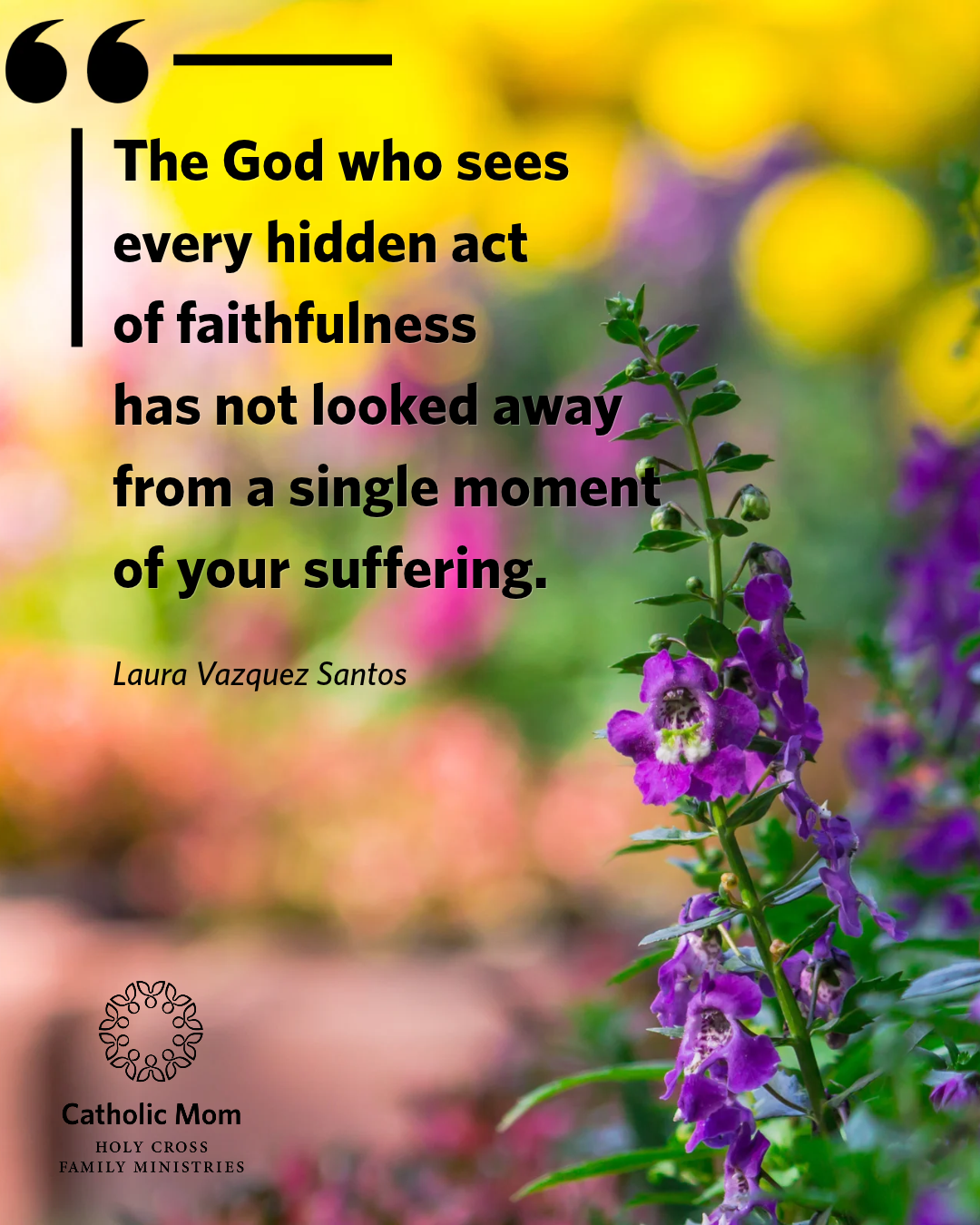
The God who sees every hidden act of faithfulness has not looked away from a single moment of your suffering.
He is still there. Especially in the garden.
Share your thoughts with the Catholic Mom community! You'll find the comment box below the author's bio and list of recommended articles.
Copyright 2026 Laura Vazquez Santos
Images: Canva


About the Author



Comments