



Stephanie Quesnelle explains how parents can talk to their kids about appropriate cautions surrounding the use of artificial intelligence.
A few weeks ago, my 6-year-old came home from school and asked, “Why is artificial intelligence so bad?” Apparently, a group of first-graders were repeating conversations they overheard about environmental challenges, but she mostly knows that her dad works on AI and that it’s a way for computers to process information faster. Why would her dad do something bad?
That conversation has stuck with me because I keep seeing parents and teachers say that they’re just going to disallow their kids using AI. And honestly, I get it. My kids are very limited on screens. However, just not talking about artificial intelligence isn’t an option because AI is shaping every aspect of our public discourse, including first-grade lunch table conversations.
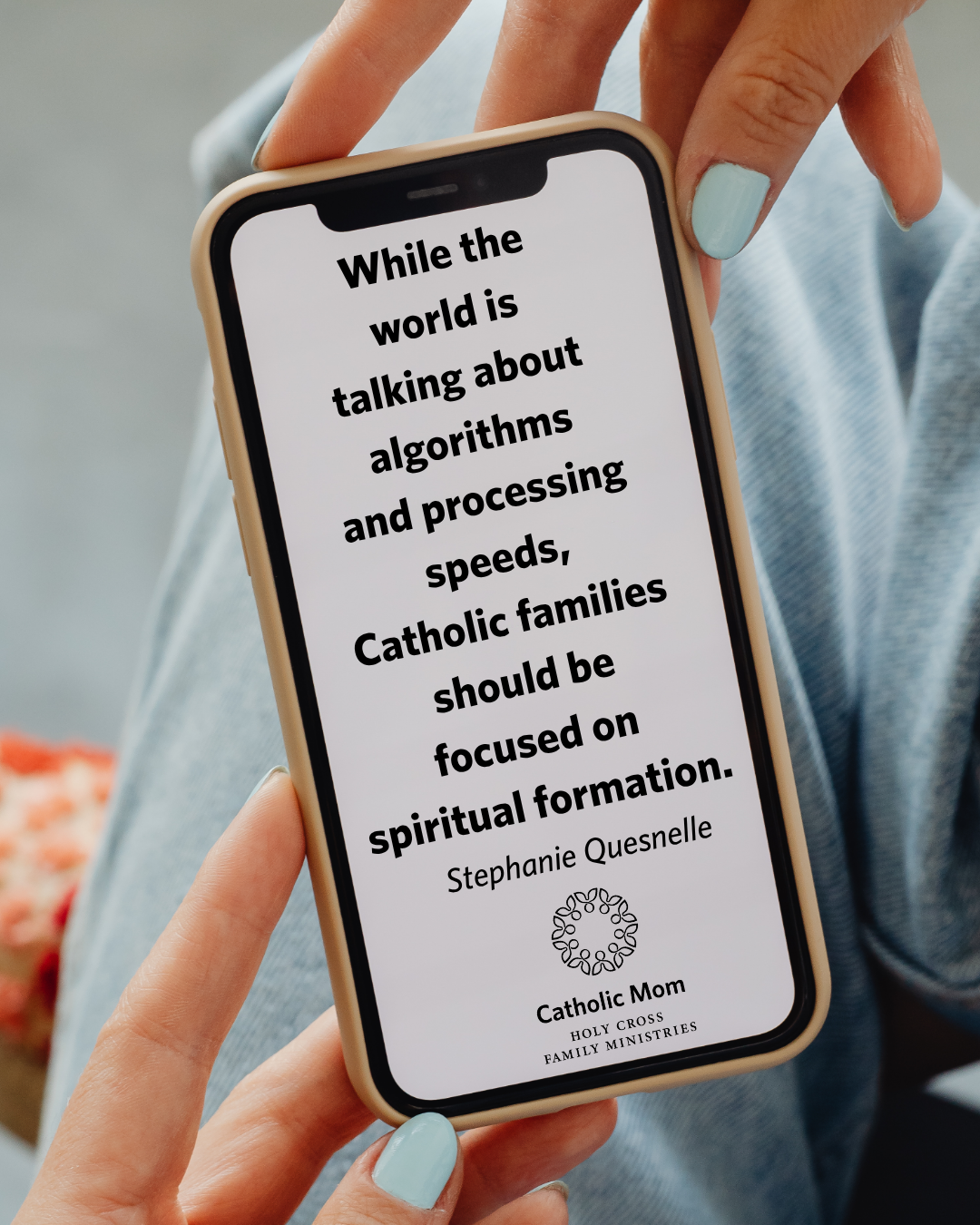
In Magnifica Humanitas, Pope Leo XIV said that the family is "the first environment in which all persons develop their potential, become aware of their dignity, and learn the earliest forms of truth and goodness." While the world is talking about algorithms and processing speeds, Catholic families should be focused on spiritual formation. This isn’t sidestepping the AI conversation; it’s making sure our kids have a foundation for confronting the coming questions on consciousness, relationships, and what it means to be human.
You're Already Doing It
In our Catholic families, a lot of these important conversations are already happening. The formation from Mass, shared meals, catechism classes, and other time together is the foundation for everything your kids will need to navigate a world shaped by artificial intelligence.
You don't need to understand how a large language model works to teach your child that a chatbot is not a friend. You need basic Catholic theology, teaching children that they are made in God’s image and they are not defined by what they do or don’t accomplish. Through this Catholic formation, you're teaching them the most important thing Magnifica Humanitas had to say: that our dignity is given by God and "no machine can ever replace" it (15).
Bridging the Gap
While the foundation can be laid without ever discussing artificial intelligence explicitly, my daughter’s experience with her classmates shows we do need to have more specific conversations. Normal life presents a wide variety of opportunities to point out the faulty nature of computers.
Just the other day, I was driving through my neighborhood when I noticed that my car’s computer was telling me that the speed limit is 70 mph. This persisted, even when I pulled into my driveway and came to a complete stop! Moments like these are a great time to point out the computer’s error and discuss the potential consequences of following blindly.
We can also have conversations about chatbots that show up at school or in conversations with friends. Kids might experience computer-graded homework, which gives an opportunity to compare human vs computer interactions. Video games might integrate automatic translations, which gives an opportunity to discuss how the computer swapped words without really understanding them.
The tougher conversations are when AI isn’t wrong, but also isn’t being used well: chatbots tempting children and teens with friendship through constant affirmations, perfectly recommended content to hook us into social media apps longer, and the like. That’s when formation matters most: helping our children identify when a computer mimics human empathy and understanding.
These conversations can flow naturally from the interactions with technology already in our lives without being soap-box lectures or lengthy discourse. Just last month, my fellow Catholic Mom contributor Janelle Peregoy offered even more ideas for age-appropriate tech formation.
Each family’s experience with AI is going to be unique to their relationship with technology, so there’s not a single right conversation to be had, but the conversations need to start.

Back to Basics
For our children, the starting point doesn’t need to be the complicated descriptions about matrix algebra or in-depth analysis about human consciousness. We don’t have to get bogged down in the details of Magnifica Humanitas or Catholic Social Teaching. Our kids need basic Catholic formation, the everyday moments that shape each of our domestic churches. By starting there, we fulfill the role Pope Leo identified for the domestic church: starting with human dignity, truth, and goodness.
As for my daughter’s question about AI being “bad,” we’re still talking about it. That’s the point.
Share your thoughts with the Catholic Mom community! You'll find the comment box below the author's bio and list of recommended articles.
Copyright 2026 Stephanie Quesnelle
Images: Canva


About the Author


.png?width=1806&height=731&name=CatholicMom_hcfm_logo1_pos_871c_2728c%20(002).png "CatholicMom_hcfm_logo1_pos_871c_2728c (002)")


Comments