


-1.png)
For Holy Women's History Month, Andrea Bear shares how part of Sister Wilhelmina Lancaster's legacy has inspired her to look first toward pleasing God.
For most of my life I have struggled with people pleasing. What will others think of me? How do I make others happy? But it wasn’t until the summer of 2024 where I began to see how serving God over serving man was really the most important type of pleasing. I discovered this in two places: through the example of Sister Wilhelmina Lancaster and through veiling.
What Will People Think of Me?
Veiling has more recently become popular in Catholic circles, but for decades, it seemed to be a dying practice. I felt attracted to veiling but I never fully understood its purpose and believed it only drew attention. “What will people think of me? Will they think I’m trying to be holier than I really am?”
But that summer a cross-country road trip led me to visit the incorrupt body of Sister Wilhelmina Lancaster, the founder of the Benedictines of Mary, Queen of the Apostles in Gower, Missouri. While her case for beatification has not yet been officially opened, I knew there was something incredibly special about my visit to see her. At the gift shop, I picked up a copy of her biography God’s Will, compiled by her community.
Sister Wilhelmina wrote beautiful poetry and created small hymns and devotionals about the Blessed Mother. But what piqued my interest most was her devotion to the traditional veil and the Latin Mass. Around the 1960s, she became greatly disturbed by the modernistic loosening of standards after Vatican II. Her own order, the Oblate Sisters of Providence, had changed from their full veil to a more relaxed habit, exposing the hair and neckline. Sister Wilhelmina began to believe that this loosening of standards was changing the draw of the Church. Her own order had reduced in size from more than 100 sisters to less than half that number. She attributed such leaving to the lack of tradition.
A Single Focus: Giving Glory to God
While I can’t confirm or deny whether her theory was true, what I found so appealing about Sister Wilhelmina was her utmost focus to giving glory to God. Saint Paul writes,
Any man who prays or prophesies with his head covered brings shame upon his head. But any woman who prays or prophesies with her head unveiled brings shame upon her head. (1 Corinthians 11:4-5a)
While the Church has never done away with this tradition, I have noticed over the last couple years many are returning to make this a more common practice, and its appeal to return to tradition. When we think of times of prayer, and even the national anthem, men often remove their hat as a form of respect and reverence. But I had never considered that women might cover theirs. As Saint Paul points out, a woman is the glory of man because she is made in the image of man, but Man is made in the image and glory of God (1 Corinthians 11:7-8).
As I read Sister Wilhelmina's biography and I saw how she valued tradition, I admired her courage to persevere. As a people pleaser, I often mixed up where praise belonged. Praise to others? Praise to myself? Yet unknowingly until that trip, I had rarely shown praise to God. Sister Wilhelmina’s refusal to break from tradition and not worrying what others thought of her helped me have the courage to reprioritize where and WHO received praise.
Ironically in my first attempt at veiling, I felt this interior anxiety. “Everyone is watching me.” But it was in that same moment, I realized that this is not about everyone else. This is about giving God glory. For the first few months of my veiling, I struggled with appearances, and ironically found my veiling served as a sacrifice of my vanity. In turn, this helped develop my prayer life. The veil from its exterior served as a reminder to me why I was in mass in the first place. In times where I may have been more chatty or social, the veil helped me remember to show reverence in front of the tabernacle.
In the 1990s, Sister Wilhelmina founded a new religious order, the Benedictines of Mary, Queen of Apostles. While there is no direct physical evidence of Sister Wilhelmina’s veiling being a direct link to her growing order, the attractiveness of tradition has become apparent, as her order has grown to four houses, even one internationally in England.
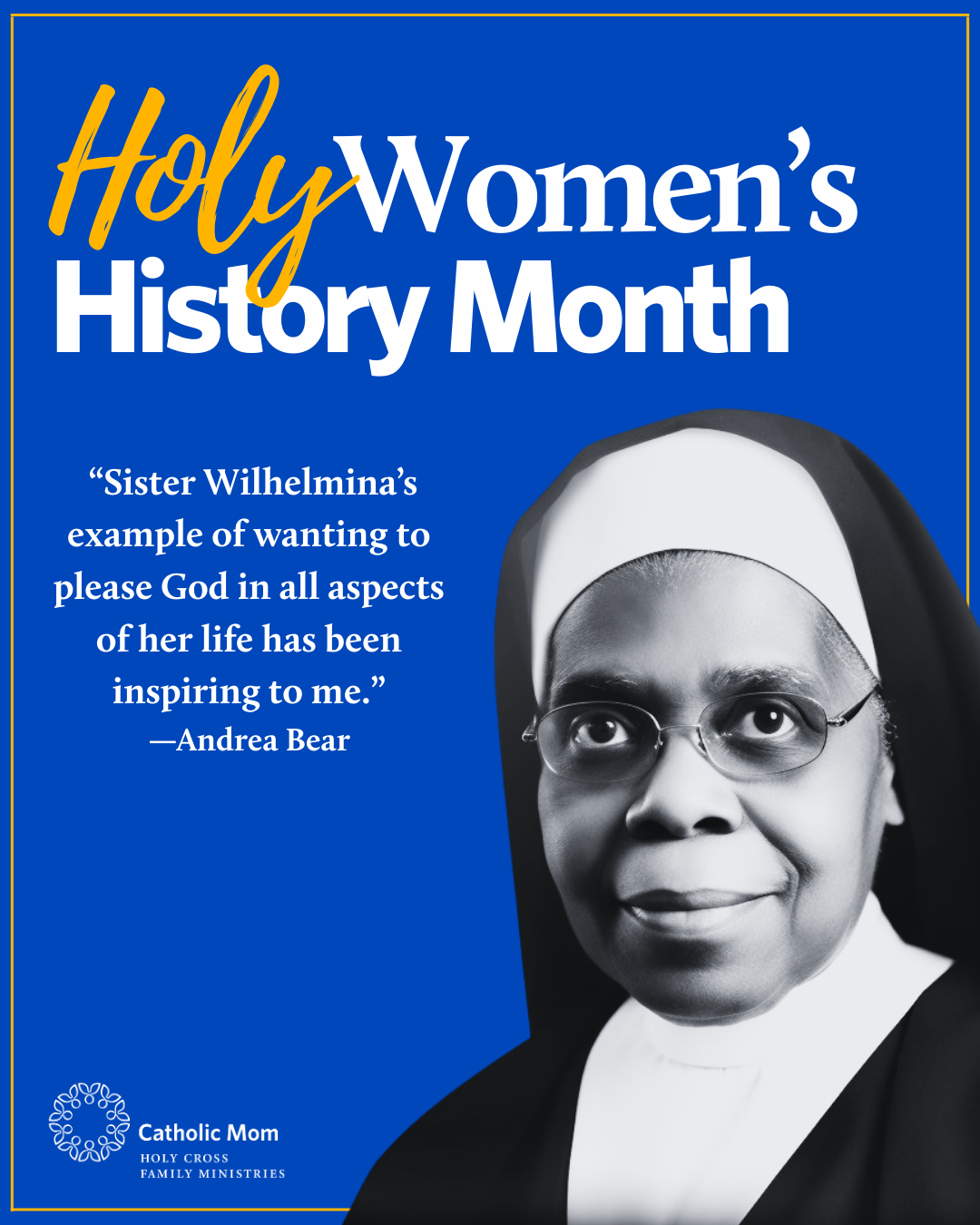
Sister Wilhelmina’s example of wanting to please God in all aspects of her life has been inspiring to me. Even on her deathbed, her sisters noticed that she felt the most comfortable in her habit. Through Sister Wilhelmina’s example, I learned that our service is to give God glory. Even in our work, the goal is not to praise ourselves, but to praise God for the great gifts He gives us to serve and in this we must give Him thanks for these gifts. And this is what is most pleasing.
Sister Wilhelmina, pray for us
Read more of our Holy Women's History Month stories.

Share your thoughts with the Catholic Mom community! You'll find the comment box below the author's bio and list of recommended articles.
Copyright 2026 Andrea Bear
Images: (banner) Trinity Mirror / Mirrorpix / Alamy Stock Photo; ChatGPT


About the Author


.png?width=1806&height=731&name=CatholicMom_hcfm_logo1_pos_871c_2728c%20(002).png "CatholicMom_hcfm_logo1_pos_871c_2728c (002)")


Comments